
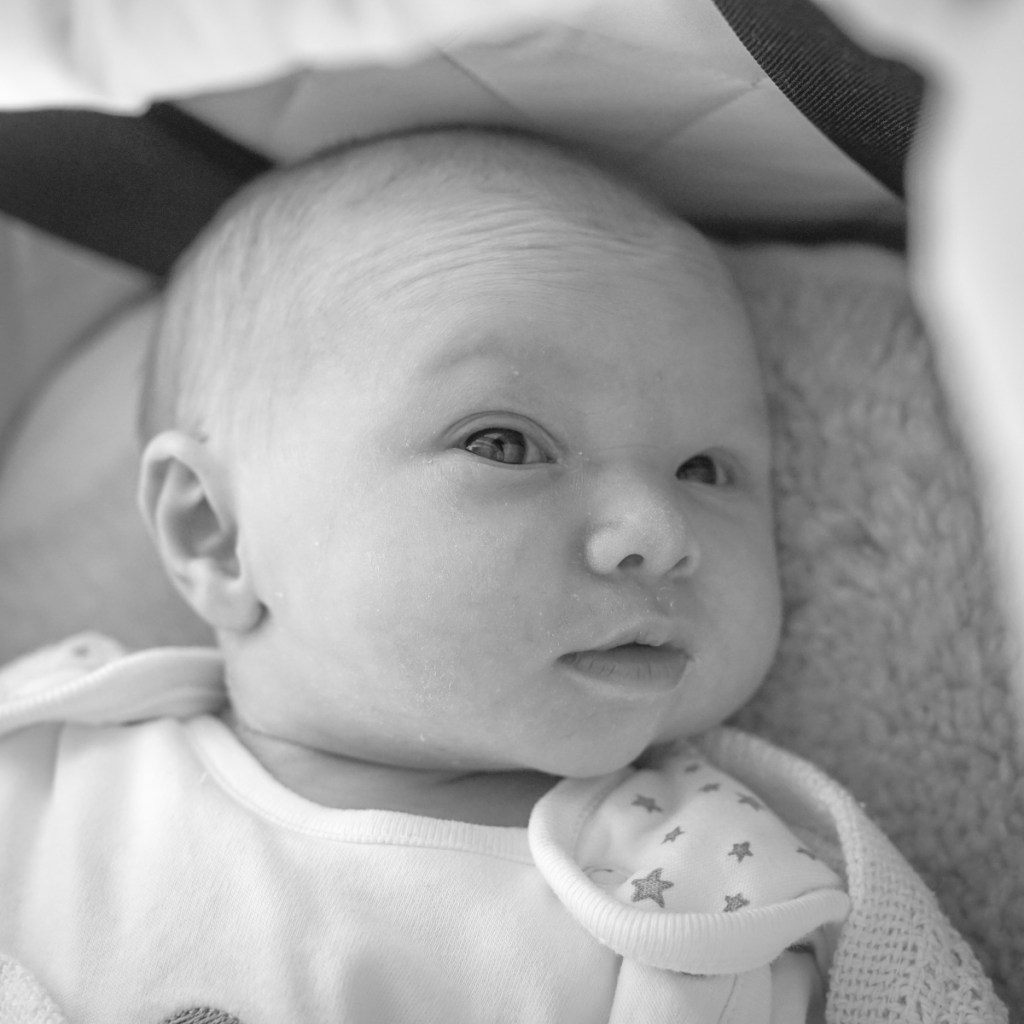
‘It’s easy to get caught up in material reality and forget what really matters. Caring for a newborn infant is a particularly clear example of this. Your life is made up of activities necessary for the care and maintenance of a body: feeding and cleaning and sleeping, inputs and outputs; these are all material measures. It’s easy to let those measures dominate your perspective and determine what you see.
That would be a mistake. It only takes a moment’s philosophical reflection to see that your baby is more than just their body. They are not only a physical thing but also a mind and a will and a perspective, something that feels and thinks (to the extent that they can ‘think’ in pre-linguistic terms). A short-hand way of saying this is that your baby is a soul, utterly unique and immeasurably precious. The measures of material reality, whilst necessary, cannot capture what that means.
If you let those measures dominate your view, only looking at the material reality, then you will have lost touch with reality and with it any possible connection with the truth. For all your attention on their material needs, you will have lost sight of what it means to care for an infant. Yes, there are material necessities, but that is not all there is. Don’t let those material necessities blind you to what really matters.
This takes effort: your body is material and because of this it will want to drag you down to live in that material world. You think only of food and sleep and physical things. You need to make an active choice to fight against that tendency and adopt a higher perspective, using your reasoning faculty to see things as they really are and make some attempt to live in accordance with that understanding. Caring for a body is a soulless grind; caring for a soul is infinitely rewarding. The truth of the matter is that your baby is a soul and you are caring for that soul. You should see that for what it is.’
The preceding paragraphs were a note written to myself before the event, whilst my wife was pregnant with our first child and we were doing the standard pre-parenthood classes. Before I had a child, I had no experience with babies. There is a lot to learn when it comes to looking after a baby, and that’s true for everyone, but it was especially true for me. I was trying to prepare myself as best I could.
When our time came, I was glad to have made these efforts. More important than feeling like I knew what I was doing, I felt like I knew and could clearly see what I was aiming to be. If ever I lost sight of that, I reminded myself: look beyond the body and see what this means. There is a pattern of life that we call ‘good’; you live well to the extent that you resemble that pattern. The goal in life is not to have more of what is good (which in those weeks is always sleep) but to be more of what is good (which in those weeks is always calm, responsive, giving, steady, capable).
Human beings have a tendency to get caught up in their own physical reality whenever it forces itself on us: when we are hungry, or tired, or in pain. It’s necessary to meet these needs but if that’s all you are ever doing then it can become a corrupting thing. Constant pain or hunger or fatigue blinds you to any other reality. As Dostoevsky said, people have a tendency to become monsters in their misery.
The early weeks of caring for a newborn infant are not miserable but they are exhausting. Stress and sleep-deprivation have their effects, and if we are not careful then we can be led by that natural tendency to get locked in our physical reality, as we try our best to meet a newborn’s material needs. All parental roles are vulnerable to this tendency but I wonder if it is a particular risk for fathers. Often, due to certain biological facts about birthing and feeding (and old-fashioned gender norms, of course), the role of the father becomes that of seeing to all the practicalities beyond those in direct contact with the child. The mother sits with the baby whilst we fetch and carry things, we drive, we build the furniture, we clean the things and empty the bins. These are all necessary tasks, but the infant knows nothing of that. These activities are not particularly soulful, and all the time you are doing them you are not connecting with your child. Without care, you become a soulless thing: a body tending to the needs of a body.
But as Socrates says in the Phaedo, the body is unreliable: it cannot see truth and meaning but only physical things. You can measure your baby’s temperature with a thermometer, but can you measure their importance to you, or your duty to them? Have you seen your baby’s soul with your eyes? But you know what it means to say that your baby has an inner life, and that this inner life is as important and perhaps, in the end, more important than their body. They can cope with a missed feed or nap, but if you once lose your temper then that fear might mark them forever.
The mind or the understanding or what ancient philosophers would call the ‘ruling faculty’ is more reliable. Only it is capable of knowing what is best. At this time, more than ever, you should put it in charge and do what you have most reason to do.
Because for most people who have children, few things are more important in life than our children. And when can you do most for your child? When must you do most for your child? When does your child need you most, and when are your time and resources of most benefit for your child? The answer here is always ‘the first weeks/months/years’. So why would you not give everything you can to this time?
‘This instant, then, think yourself worthy of living as a man grown up, and a proficient. Let whatever appears to be the best be to you an inviolable law. And if any instance of pain or pleasure, or glory or disgrace, is set before you, remember that now is the combat, now the Olympiad comes on, nor can it be put off. By once being defeated and giving way, proficiency is lost, or by the contrary preserved. Thus Socrates became perfect, improving himself by everything, attending to nothing but reason. And though you are not yet a Socrates, you ought, however, to live as one desirous of becoming a Socrates.’
Epictetus, Enchiridion #50
Read more: Think Well, Live Well: A Free Introduction to Philosophy
 tobybetenson.com