
Recently, I’ve been running a series of posts about the problem of evil. Much of it is recycled and taken out of context from my book on the subject. The main motivation for this is SEO: I want to teach the Google bots that my writing here is what should be read, rather than my old academic writing. This is the second time in this project where I’ve tailored what I’m doing to some purpose other than a good and authentic purpose.
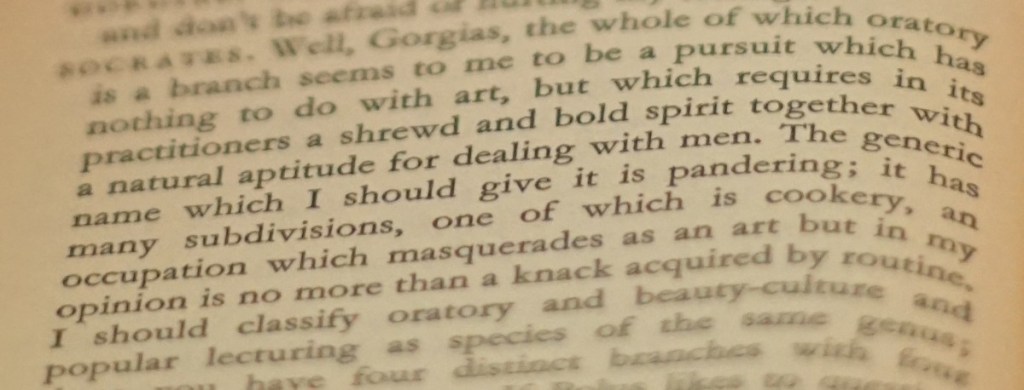
Ancient Greek philosophers had a word for this kind of thing: κολακεία. It is variously translated as ‘pandering’ or ‘flattery’. It means ingratiating yourself to someone by telling them little lies. It means playing to the crowd. It means putting the pursuit of truth aside in favour of the pursuit of other people’s good opinion. It means giving people what they want, even if it’s not what they need. In my case, it means trying to give the Google bots what they can understand.
Socrates was scornful of such things; which might seem ironic, given how often he deploys the tactic in Plato’s dialogues. But the difference with Socrates’ use of the tactic is that he does it only with the ultimate good aim of helping us. He knows that no one will be taught who is not willing to learn, so he will do what he must to get us to be willing participants in his pursuit of truth. If he has to pander to us to do so, then he will, but only until we realise it is pandering; then its job is done and we can move on to what matters.
For Socrates, κολακεία serves a purpose, and a good purpose at that: it is a means to a good end. But for most of the people Socrates is pitted against, κολακεία is more than just a means to an end: it is a skill to be cultivated in order to get ahead in the world. It is a highly-prized skill and the Sophists charge a high price for teaching it. Rather like SEO…
A Trade in Ignorance
The currency of κολακεία is ignorance. It succeeds only because people don’t know any better. Someone stands before an audience and panders to them successfully. They rattle off a string of little lies and half-truths and misunderstandings that play well with the crowd. They tell them what they want to hear. If we ask ‘did the speaker speak well?’ the crowd agrees that they did, because they like what they heard.
What is the measure of this success? Popularity. Only: ‘how many people liked it?’ (Sound familiar?) In this case the answer is ‘many’. But only because most of these people didn’t see the lies and the half-truths and the misunderstandings and the pandering because they didn’t know any better.
What would a knowledgeable person think of the speech, someone who knows what they’re talking about? They see the lies and half-truths and misunderstandings and pandering. What is their answer to the question ‘did the speaker speak well?’?
It is different from the crowd. The knowledgeable person says the speaker spoke badly: they lied, they showed their ignorance, they made a fool of themselves. The only thing they did well was to hide their ignorance from the crowd, but this isn’t something to be celebrated. It’s clear to the knowledgeable person that the speaker doesn’t know what they’re talking about.
What is the measure of this failure? Truth. Only: ‘did they speak truly?’ In this case the answer is ‘no’. The knowledgeable person can see this, knowing what they do.
By the measures of popularity, pandering succeeds; by the measures of truth, it fails. Clearly only one of these is a serious option for anyone who would call themselves a philosopher.
Pandering succeeds with the crowd but fails with the knowledgeable. Which means that pandering only works when the crowd is ignorant. It is a kind of con-artistry that wins when other people lose: it succeeds when someone is successfully kept in ignorance.
When this is put to the purpose of personal gain it is a vicious thing, because in order to continue in your success you need to keep the crowd ignorant. If you teach them too well, they’ll see through you, and you’ll have nothing left to sell.
Anyone seriously interested in educating the crowd would not pander to them, or at least would not do so for personal benefit but only for the benefit of their audience. A virtuous speaker would celebrate when the crowd sees through their lies, just as Socrates would celebrate if he were shown to be in error.
Knowing all this, why would anyone engage in such a tactic?
A Means to a Good End
I suspect Socrates didn’t have much interest in most of the topics of conversation represented in Plato’s dialogues. I suspect Plato had more interest in these fine technical discussions, which is why they feature so prominently in the later dialogues. But Socrates seems to me to be relentlessly circling around the same question: What is virtue? And this only to answer the only question that matters: How should I live?
Socrates uses all of his technical discussions and rhetorical ploys as ways to drag us back to his one question. And of course, whilst he might say that he wants an answer from us, in truth he only really wants us to ask the question with him. Because it’s the process of asking the question and trying to provide a good answer that gets us onto the path of trying to live better as human beings.
Ironically, the purpose of asking the question ‘what is virtue?’ is not to answer it. The purpose of asking this question is only to get us to try to be more virtuous. To that good end Socrates will allow himself a little irony, or a lot. Socrates will pander to people and con them into having a discussion about something enjoyable (like love or pleasure) or aristocratic (like courage or rhetoric), but in the end this discussion will always bring them back to a reflection on virtue.
Socrates himself profits by none of it. I think that’s an important point and probably a significant reason why ancient philosophers were so ardent about not charging fees for their teaching. As soon as you gain from these things, you become exactly what you know you should not be: a sophist. It will then be in your interest to keep your audience ignorant so that you can keep selling them lies.
The Problem of Evil
I have little interest in pursuing the academic discussions on the problem of evil because I am no longer sure what good purpose they serve. Why, then, do I recycle them?
In my ironically-not-so-humble way, it’s because I am trying to do what Socrates did. I think the problem of evil is one fine technical discussion in philosophy that can teach you important things about good and evil, the value of suffering, your moral perspective and limits, etc., etc. Put to a good purpose, these are all excellent things to reflect on, especially if you have any religious faith. Only remember that it’s not about winning the argument or wrestling with angels. You are wrestling only with yourself.
Philosophy is medicine for the soul, but it is a bitter medicine. It doesn’t pander to you with sweet things. It doesn’t tell you what you want to hear but what you need to hear. Philosophy works, not because it gets you what you want, but because it changes what you want. It stops you wanting things that you should not want. It teaches you what you ought to want.
Unfortunately, Google bots do not understand this. They will look at the measures of κολακεία to determine what is important, because it has no understanding or capacity for good judgement.
The Google bots, being AI, only see what doesn’t matter: the products of pandering. Being poor-sighted, they only see the largest things, and the crowd is always larger than the knowledgeable few. They see links and shares, they see ‘authority’ measured by the crowd, they see place and status. They do not see good reasoning, allusions or allegories, narrative structure, progression; they feel no rhythm or pace; they cannot get irony or jokes, pathos or bathos, absurdity; they cannot see what is shown but not said; they cannot be provoked to have their own response.
The Google bots are perpetually ignorant: you cannot teach them. And yet, they are the gatekeepers. If I want my work to be visible to human beings, I must convince the Google bots that it’s worth looking at. To that end, I must put aside my ‘writing with layered intentions’ and pursue something else: visibility according to the measures of what doesn’t matter.
I’m not sure how I feel about this. I don’t think I’ll do it very often. But you do not light a lamp in order to hide it.
Read more: The Problem of Evil as an Ethical Problem
Read more: Think Well, Live Well: A Free Introduction to Philosophy
 tobybetenson.com