
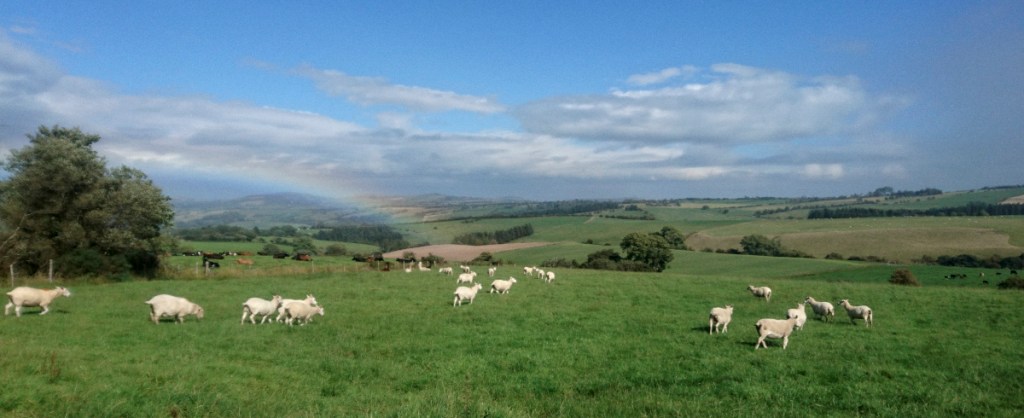
Those who speak positively about livestock farming are often accused of having fallen into an insidious ‘Romanticism’. They view these idyllic pastoral scenes with overly-sentimental eyes, and this clouds their judgement.
Is this true? If it were, it might be a problem: it is important to see things clearly – undistorted – and sentimentalism is one of the many distortions of thought that can creep in, like prejudice and other forms of bias.
But I say it only might be a problem, because it depends on the question at hand. If you ask me to account for the love that I have for my wife and child ‘but don’t go getting all sentimental on me: please stick to the facts’, I will say that you are being unreasonable. What it means to love your family is not something that can be separated from forms of thinking that are essentially vulnerable to sentimentalism and its like; to rid yourself of that vulnerability by ‘sticking to the facts’ is to deny yourself the possibility of having any contact with the reality of the matter.
It would not be an ideal picture of human thinking to understand familial love in an ‘unsentimental’ way. Most people recognise this. That is why they reach to poetry, literature, art, music, and in short anything that could elicit a ‘reaction in human terms’ in an attempt to capture the full meaning of these things. It is not something that can be captured in shallow terms that ‘stick to the facts’.
I understand ethics to be the same, not least because it’s quite possible that ethics is grounded in our relationships with one another. If the meaning of those relationships cannot be reduced to a shallow ‘sticking to the facts’, then neither can any ethical obligations that follow from them.
Would our obligations to the environment be any different?
Environmental Ethics
They might be. It seems clear that our obligations to the environment are going to be satisfied, in part, by making the right decisions on the basis of a set of very particular calculations. These calculations, and therefore the decisions on which they are based, are based on facts, and these facts are based on measurements and theory.
When you are gathering measurements and developing theory about the natural world, it is important that you ‘stick to the facts’. That is how the natural sciences work and how they ought to work: you do not want any creeping metaphysics becoming imbued into your measuring apparatus, or else you will begin to see only what you already believe to be true. Hence the standing requirement for ‘objectivity’ in the scientific method. And it’s clear that sentimentalism, Romanticism, and their like, have no place in that method and should be cast out without hesitation.
This principle forms the basis for the accusation of ‘Romanticism’ towards those who speak positively of the livestock landscape. Their love for their animals and their land causes them to ignore the facts and skew the numbers in favour of a pre-favoured ideal. Is this true?
Am I?
It’s not my business to judge what other people do; I can only ask questions of myself and put my thoughts to the test, like a good student of Socrates. And so I ask myself, as a philosopher and a livestock farmer: am I being Romantic?
I don’t ignore the facts. I read every study that I come across, and my academic background compels me to delve through the references in every article and read these studies with a critical eye; and rightly so, because they often do have glaring omissions, errors, or biases. But this isn’t driven by Romanticism: I would describe it more simply as an academic’s irritation that people become too easily blind to their own biases.
And so, e.g., if you say that eating beef is bad in the UK because of deforestation and soya, then I will say that you’ve stated a non sequitur because those things are not meaningfully connected. Either you have deliberately misrepresented the situation, which is bad and will cause me to question your motives, or else you are ignorant of the realities of beef farming in the UK (realities that the tiniest glance would have revealed to you in a flash), which might be worse for someone claiming to be an authority on ‘the facts’ and will cause me to question your judgement and authority to speak on these things. Because I don’t want to hear anything from the ignorant; they have nothing to say to me.
When I come across data that is meaningful, I take it on board without prejudice. It is important for me to learn what I can about these things, because my ethical decision-making depends upon having an accurate understanding of reality. I orient myself, ethically, towards this reality. And as a result, I would not use artificial fertiliser or pesticides, I would aim for lower stocking densities, I would manage my manure responsibly, I would plant and maintain trees and hedgerows in a way that benefits the local wildlife, I would never feed my cows anything but grass from my land, I would rotate the grazing and manage the landscape well, I would reduce the use of machinery to the bare minimum, etc., etc. In short, I would do everything that the facts suggest that I ought to do.
And in addition to this, I turn my thermostat down, I add solar panels, I do not take flights or holidays, I avoid unnecessary journeys, I eat simply using local produce whenever possible, I wear clothes until they become old and fall apart, and in short in all ways that I can imagine I consume less.
I don’t try very hard, since I don’t think anyone is under any obligation to do everything they can but only as much as is their fair share (whatever more they want to do beyond that is up to them). But in any case I take to this self-imposed poverty easily, as a philosopher sympathetic to the Cynics and influenced by Socrates: I understand that the goal in life is to be more of what is good, not to have more good things.
Is this Romantic? I suspect it is. If you ask me to offer a comprehensive rational account of my ethics, in a way that ‘sticks to the facts’, I will fall short. Every great philosopher has come to understand that reason has its limits (not that I put myself in that category but I’ll gladly take their lessons), and when we hit those limits we can only say ‘here I can say no more’.
Rightness
If you ask me to account for the rightness of what I do on the farm, I will appeal to those facts that suggest that this particular form of livestock farming – extensive, grass fed, organic, and on well-managed land that could not reasonably be used for any other food-productive purpose – is carbon negative and likely to be emissions neutral. This isn’t a certainty, since there is a wide margin for error, but it is a reasonable inference on the basis of the data. The farm I work on doesn’t carry any of the most-damaging environmental baggage associated with other forms of farming.
But that is a shallow answer in shallow terms: I give it only because you ask for it. If you allow me to push further I will start to drift into the undeniably Romantic. I will say that there is something about this form of living alongside non-human animals that is ‘natural’.
I put it in inverted commas because I’m not sure what I mean. It is Nature, spoken about with reverence enough to warrant a capital ‘N’. It is life and death and digestion. It is changes and the Dao. It isn’t ‘clean’ or ‘precise’; it is muddy.
It is organic life and all that comes with it, and I would choose that over plastic and a machine even if I had no good reason. I am not poetic enough to express this sentiment – perhaps a life in academic philosophy has killed that in me – but I have enough humanity left to recognise the reality of it. It is not a reality that can be captured adequately in data on a spreadsheet or reports from a scientific journal. It is not a reality that can be seen from the city.
You would recognise it if you felt the air here, or the soil beneath your feet. You would recognise it if you heard the birds, or saw the insects, or shovelled shit.
I know that anyone who talks like that is definitely liable to accusations of Romanticism. And if so then I say: so much the better for Romanticism. Because I would rather live and die in that deep world, rich with meaning, than subsist in the shallow alternative.
Concluding Unscientific Postscript
Philosophers have been thinking deeply about these things for thousands of years. A lifetime of study could not exhaust these rich resources. Any suitably-informed philosopher nowadays has plenty of material to draw on, and most of us ‘lovers of wisdom’ – who want to understand whatever truth there is to understand – do not allow ourselves to be scientifically illiterate or ignorant. But from the way they carry on, it seems as if many environmental scientists (and those who quote them) have not even investigated these matters; not once thought seriously about them. Their understanding of ethics is no better than a child’s.
Talk of scientific illiteracy is one thing, but can you imagine how ignorant the shallow scientist seems to the philosopher? And as I said: the ignorant have nothing to say to me that I want to hear. Nothing important, anyway.
Related articles: The Livestock Landscape, The Environmental Impact of Beef Consumption: The Meaninglessness of the ‘Global Mean’
Read more: Think Well, Live Well: A Free Introduction to Philosophy
 tobybetenson.com