
He began life as all life begins: free and completely dependent.
He was taken care of by people who cared for him until he came to consciousness and realised that he could take care of himself.
He started to learn how to take care of himself. When he showed how he could take care of himself, he was praised. ‘You’ve done well’, they said, ‘and you should be rewarded.’
He agreed. He had done well. He decided he should learn some things in order to take better care of himself.
He went to school and learned some things. He was good at learning things. When he showed what he’d learned, he was praised. ‘You’ve done well’, they said, ‘and you should be rewarded.’
He agreed. He had done well. He decided he should do more of this thing that he does well, and so he went to university to learn more things in order to take better care of himself.
He went to university and learned more things. He was good at learning more things. When he showed what more he’d learned, he was praised. ‘You’ve done well’, they said, ‘and you should be rewarded.’
He agreed. He had done well. But he decided that he had learned enough things now and it was time to do something with what he’d learned in order to take better care of himself. It was time to make something of himself. He applied for a job.
He got a job working for a company that sold something. The company didn’t make anything, and what it sold was not made of anything. But he was good at selling these things that were made of nothing. When he sold enough things, he was praised. ‘You’ve done well’, they said, ‘and you should be rewarded.’
He agreed. He had done well. He decided to keep selling these things that were made of nothing in order to make something of himself.
He kept selling these things, and he sold a lot of these things, and he had been selling these things for so long that he got promoted. ‘You’ve done well’, they said, ‘and you should be rewarded.’
He agreed. He had done well. He decided he should do more of this thing that he does well, and so he worked hard to get his next promotion in order make something of himself.
He became a manager. He didn’t make anything; he didn’t sell anything. He managed people who sold things that were made of nothing. For this he was richly rewarded.
One day he was told that they weren’t selling enough things. He was told that they weren’t making a profit. He was told that the only solution was to cut costs by firing some of the people who sold the things that were made of nothing.
They said it was necessary and he agreed. He fired some of the people who sold the things that were made of nothing. ‘You’ve done well’, they said, ‘and you should be rewarded.’
He agreed. He had done well. It wasn’t an easy job, firing people, but someone needs to do what needs to be done.
One day he realised that he had quite a lot of money. He decided to use his money to buy a house in order to take better care of himself.
But even with all the money he had, he couldn’t afford to buy a house. So he went to the bank to get a loan. The bank agreed to give him a loan that would enable him to buy a house, but only if he agreed to pay the bank half of everything he earned for the rest of his life.
They said it was necessary and he agreed. He agreed to give the bank half of everything he earned for the rest of his life. ‘You’ve done well’, they said, ‘and you should be rewarded.’
He agreed. He had done well. Now he owned a house. But though he’d thought that this would’ve made him feel more secure, instead he felt less secure, and so he wondered what people meant by ‘security’. He thought about how a prisoner doesn’t feel more secure behind bars, but a prison warden feels more secure because of the bars.
Now that he owned a house he didn’t have any money. He decided he needed to get more money, in order to take better care of himself, so he asked his company for a pay rise. They refused.
It was impossible, they said, and he agreed. He decided to keep working and living in his house without having any money. But he began to realise that he wasn’t feeling very well.
One day he felt very tired. He asked for some time off work, in order to take better care of himself, but they refused. It was impossible, they said, and he agreed. The company was already stretched too thin.
One day he was told that the company needed to ‘restructure’. Staff would be cut by 30% and all managers had to reapply for their jobs. In a noble show of solidarity, one of the managers suggested that they each take a 10% pay cut in order to avoid any lay-offs, but all of the managers rejected this idea because it was impossible.
He agreed. He could barely afford to live with what he had, let alone with less. He applied for his job and got it, in order to make something of himself, but his job was now the work of two jobs. ‘You’ve done well’, they said, ‘and you should be rewarded.’
He wondered what they meant by ‘reward’. He thought about the etymology of the word and how it shares a common origin with ‘watching’ and ‘guarding’.
One day he was called into a meeting with senior management. ‘Your performance has dropped’, they said, ‘and we need you to do more.’ He doubted that he could do more but it was necessary, they said, so he agreed that he would do more.
He was now very tired, but he understood that all of this was necessary in order to make something of himself.
One day he took some holiday and decided to visit his family. They asked him about his work and his life and he told them. ‘You’ve done well for yourself’, they all said, but he disagreed.
He didn’t think he’d done well for himself at all.
They told him that he had achieved a lot in his work, but he didn’t feel that he had achieved anything at all. They told him that by owning a house he had security, but he didn’t feel any more secure. They told him that he had done well to manage the work of two jobs, but he didn’t understand why this was a good thing. They told him that he had really made something of himself, but he wasn’t sure what he’d made.
They were praising him but he didn’t feel proud. He felt ashamed, but he didn’t understand why he felt ashamed. He had done well and he should be rewarded. But he realised that what he had been doing didn’t really matter, however well he did it, and what he had been rewarded with wasn’t doing him any good, however much he got; and because of this he no longer understood what it meant to ‘do well for yourself’.
One day, feeling the need to escape from his world, the world that he had made for himself, he picked up a book. The book he happened to chance upon told of a strange professor specialising in the philosophy of clothes. There he read this:
‘Not what I Have but what I Do is my Kingdom. To each is given a certain inward Talent, a certain outward Environment of Fortune; to each, by wisest combination of these two, a certain maximum of Capability. But the hardest problem were ever this first: To find by study of yourself, and of the ground you stand on, what your combined inward and outward Capability specially is. For, alas, our young soul is all budding with Capabilities, and we see not yet which is the main and true one. Always too the new man is in a new time, under new conditions; his course can be the fac-simile of no prior one, but is by its nature original. And then how seldom will the outward Capability fit the inward: though talented wonderfully enough, we are poor, unfriended, dyspeptical, bashful; nay what is worse than all, we are foolish. Thus, in a whole imbroglio of Capabilities, we go stupidly groping about, to grope which is ours, and often clutch the wrong one: in this mad work must several years of our small term be spent, till the purblind Youth, by practice, acquire notions of distance, and become a seeing Man. Nay, many so spend their whole term, and in ever-new expectation, ever-new disappointment, shift from enterprise to enterprise, and from side to side: till at length, as exasperated striplings of threescore-and-ten, they shift into their last enterprise, that of getting buried.
Such, since the most of us are too ophthalmic, would be the general fate; were it not that one thing saves us: our Hunger. For on this ground, as the prompt nature of Hunger is well known, must a prompt choice be made: hence have we, with wise foresight, Indentures and Apprenticeships for our irrational young; whereby, in due season, the vague universality of a Man shall find himself ready-moulded into a specific Craftsman; and so thenceforth work, with much or with little waste of Capability as it may be; yet not with the worst waste, that of time. Nay even in matters spiritual, since the spiritual artist too is born blind, and does not, like certain other creatures, receive sight in nine days, but far later, sometimes never,—is it not well that there should be what we call Professions, or Bread-studies (Brodzwecke), preappointed us? Here, circling like the gin-horse, for whom partial or total blindness is no evil, the Bread-artist can travel contentedly round and round, still fancying that it is forward and forward; and realize much: for himself victual; for the world an additional horse’s power in the grand corn-mill or hemp-mill of Economic Society. For me too had such a leading-string been provided; only that it proved a neck-halter, and had nigh throttled me, till I broke it off.’
Thomas Carlyle, Sartor Resartus
He recognised the simple truth behind these elaborate words. For all his work and learning he was no more than a mill-horse, fed and watered, turning around and around in a daily grind for the economy, always with the illusion of moving forward but in reality going nowhere.
He recognised that his own life was described by a collection of paradoxes, all of which amounted to one simple contradiction: in the beginning the aim had been to take better care of himself but in the end he had made himself worse.
He was worn down by trying to make something of himself, having worked for comfort that was never comfortable, for security that was never secure, for reward that was never rewarding. He had not taken better care of himself: by trying to make something of himself, he had lost himself. He had sold himself in a bad trade.
What had he made? He began as a man but had become a mechanism; not even a mechanism but a part of a mechanism: a cog in the machine.
As that cog, he fit into the machine. He had a place. He turned in his place and it provided work. He was good for something, even if nothing was good for him.
But now, having been worn down, he was spinning freely, with no resistance, like a gear with no teeth. Now he was good for nothing.
He realised that he was glad to be good for nothing; because now, in being useless, the mechanism had no use for him and so he was free to move apart from it.
‘You need to get back to work’, they said, but he disagreed. It was impossible. Instead he read on:
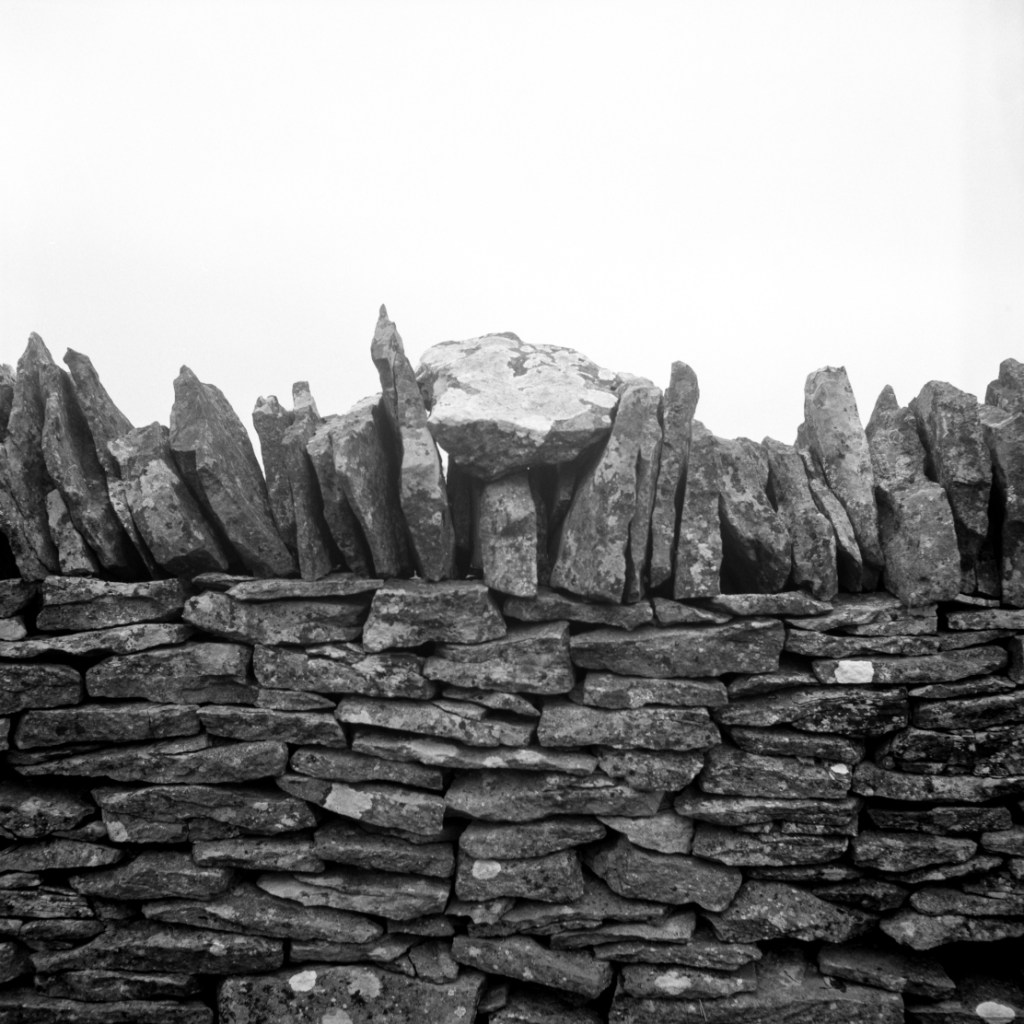
‘A young man of high talent, and high though still temper, like a young mettled colt, “breaks off his neck-halter”, and bounds forth, from his peculiar manger, into the wide world; which, alas, he finds all rigorously fenced in. Richest clover-fields tempt his eye; but to him they are forbidden pasture: either pining in progressive starvation, he must stand; or, in mad exasperation, must rush to and fro, leaping against sheer stone-walls, which he cannot leap over, which only lacerate and lame him; till at last, after thousand attempts and endurances, he, as if by miracle, clears his way; not indeed into luxuriant and luxurious clover, yet into a certain bosky wilderness where existence is still possible, and Freedom, though waited on by Scarcity, is not without sweetness.’
Thomas Carlyle, Sartor Resartus
 tobybetenson.com