
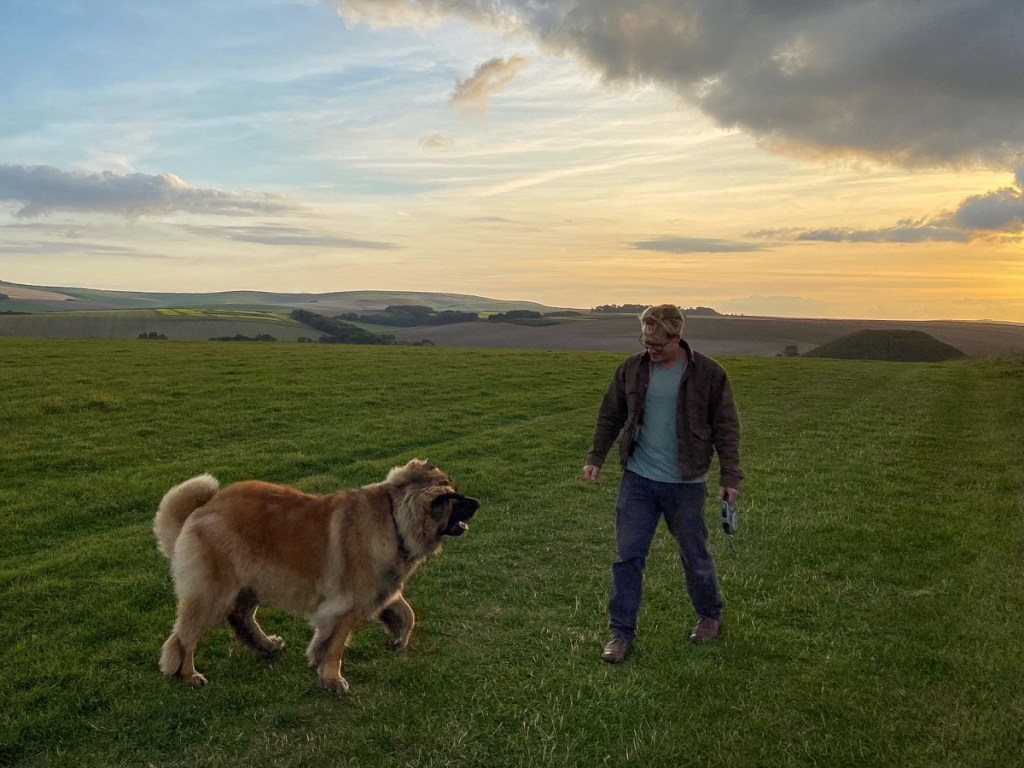
My dog died recently. This will mean different things to different people.
Some people don’t have a capacity to make a connection or to bond with animals; I know that. The phrase ‘good with animals’ isn’t mysterious; and when someone isn’t good with animals, it’s obvious. They tend to see animals as a peculiar type of object or ‘thing’, something that needs feeding and responds to conditioning but has no depth beyond that. When this thing breaks, you repair or replace, like any other thing. Of course we form sentimental attachments to these things, and it is an emotional hit when we lose them. But they will say the same of a beloved car or cup, and they will see no essential difference between losing these things and losing an animal. They will imply that it is a subjective thing: that people form bonds indiscriminately, and who are we to judge what counts as a ‘genuine’ bond? Worse, they will imply that losing a dog is like losing a goldfish.
An inability to detect the differences between these things is a consequence of a kind of aspect-blindness, I think. These people don’t see the subtlety of animal behaviour and expressions; as a result of this they fail to see the world in animal terms and so fail to participate in the animal world (as much as we can, remembering ‘if a lion could speak English still we could not understand him’). Consequently, they see no depth of meaning in animal life. Consequently, their relationship with animals remains always shallow and one way. Like having a favourite car or cup: we project meaning onto these things, but we get nothing back from them because they are not the kinds of things that generate meaning in themselves.
This aspect-blindness manifests in their behaviour, which seems utterly peculiar to those who are better with animals.
People who see animals as things have no intuitions about how to behave with them. They stand in the wrong place; they look in the wrong direction; they use their hands and face in ways that send messages they don’t intend; they shout and give instructions, and when that doesn’t work they shout louder and give simpler instructions, and then they get confused when the thing doesn’t respond to their input commands. They have no sensitivity. When the animal sends them a message – in their eyes, their body, their breath – the person has no reaction and can only reassert the expression that comes from their perspective, generating a cycle of faulty feedback: an essential and perpetual misunderstanding. When people like this are put in the position of interacting with animals, whether as a pet-owner or in a more natural setting, it is constant conflict, stress, and disturbance. A fundamental failure to communicate.
Manifestly, not everyone is like this. Some people have an ability to connect with an animal, not by doing the ‘right things’ (as if by an operating manual) but by being rightly responsive. The thousand little signals that are sent out by the body-mind are mutually detected and processed in a way that goes without saying. People like this can calm a frightened animal, or guide an animal in the right direction (when herding, say), or avoid a situation that will make an animal kick off. When these people are put in the position of interacting with animals, it is mostly calm and easy. If you ask them how they do this, they might hesitate to be able to explain fully, since they do it without thinking, but they might be able to put some of it into words (only don’t make the mistake of thinking that this is all there is to it). They make it look easy. We call them ‘good with animals’.
I think this capacity to connect with animals is natural to most human beings if only they are given the opportunity to cultivate it early in life: but even then, some will have it more than others, like any talent. It is a great gift, I think. But it comes at a terrible cost. The capacity to connect with animals tends to lead to deep bonds with some of them. Mostly the deepest of these bonds form with those animals with whom we, as human beings, are best able to connect: dogs, cats, horses. There are natural evolutionary reasons for this, which we have come to call ‘domestication’. All it means is that dogs have an ability to understand us and we them, if we are attuned.
Those who have a tendency to form these bonds will understand what it means to lose a dog. We all know that it is a part of the natural order of things that most of us will outlive our dogs. But their loss still rips a hole in your soul.
I do not know how you are supposed to deal with knowing that you will never again see someone you love, but I know that the solution cannot be to not love them in the first place.
Love is a mystery. It is irrational as if supernatural: as Socrates says, a ‘divine madness’. I can’t say I understand this mystery, and so in this case I retreat from the phrase ‘applied understanding’ and return to the word ‘attend’.
‘If you attend to what matters you will recognise how fortunate you are and this is the ultimate condition to be aimed at.’
I know I am fortunate to have the capacity to form deep bonds. I also understand the inevitability of death. And so in grief for the death of my dog all I can say is that I am fortunate to have known him and to have had him in my life. He was a wonderful friend.
Related posts: Attend to What Matters: Introduction, Willpower, Fear, Freedom
 tobybetenson.com