-
Attend to What Matters: Eutukhéō or ‘fortunate’

‘If you attend to what matters you will recognise how fortunate you are and this is the ultimate condition to be aimed at.’
-
Attend to What Matters: Freedom

My life is currently very constrained. I am occupied with looking after our 18-month old daughter. When she is awake, I am fully occupied; when she is asleep, I am on call and cannot go further than the effective range of the baby monitor.
-
The Rion: An Ancient Dialogue for Our Times
The Exile: Very nice to meet you, Rion. Am I talking to you at home? Rion: No, I’m in a hotel just outside of Bullton right now; I’ve been here to give a talk at a conference on mental health. Ex: And did they have many philosophers talking at the conference? Ri: Oh for sure, quite a lot, and lots of other writers and YouTubers. Ex: And how do you think your talk went down? Ri: It was a sell out! And it was live-streamed; mine had the most hits and likes of all of the talks. Ex: Congratulations! Presumably…
-
Do not argue about what a good life is: live it
You need to think well in order to live well, and coming to understand what it is to think and live well is the proper business of philosophy. The process of philosophy, with all its theories and methods and technical discourse, is necessary to gain this understanding, but it is not the final end of this activity. We should at some point leave it behind. […]
-
Mental Health Aspect Blindness

Something I’ve observed in people’s reactions and judgements about mental health is like a kind of colour blindness. It shows itself as an inability to discern a difference between two things that are obviously different. They cannot discern the difference between someone who is lazy and someone who is dangerously depressed, or the difference between someone who is nervous and someone who is struggling with anxiety. And because they can’t discern the difference, they treat one as if it were no different from the other. […]
-
Translation Matters: The Ergon of Stoicism

I am no expert in translating ancient languages, but I know enough to recognise when a misunderstanding has become pervasive. In popular Stoicism, the important phrase that might lead people astray is: ‘in one word, whatever are our own actions.’ Alarm bells ought to be set ringing by the obvious contradiction there: whatever is said ‘in one word’ in ancient Greek is something that takes five words to say in English. But to what ‘one word’ does this phrase refer? […]
-
Translation Matters: The Happiness of Stoicism
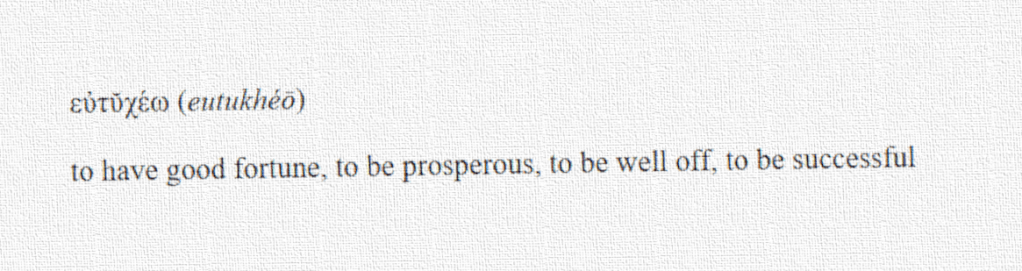
The meaning of the word ‘happiness’ has never been straightforward. Most of us aren’t clear what it means in our own language, let alone what it meant in an ancient one. This makes translation difficult. Most widely-available translations of ancient Stoic works think it easier to just say ‘happy’ and trust that people will understand more or less the right thing by that. But I think it’s an important word, and I’m not sure ‘happy’ is good enough. […]
-
Philosophy is a Magic Spell
Philosophy is like a kind of magic spell: you only need to say the right words in the right order and with the right intent you can change your world. Philosophy can turn poverty into wealth and sickness into health; it can free you from constraints, from the power of tyrants, from the fear of harm; it can protect you from yourself and warn you of errors before you make them; it can turn bad fortune into good. It is like a protective shield that makes you invulnerable to misfortune. Its effectiveness is limited to certain types of things. It…
-
The Purpose of the Problem of Evil
I think there’s something odd about discussing the weightiest matters for trivial ends. If I’m being honest, I think philosophers have lost sight of their true purpose, their ‘that for the sake of which’ they philosophise, especially about the problem of evil. Once upon a time, the purpose of philosophizing about the problem was to correct our attitude to the world, one way or another. Whether to alleviate our anxieties about pleasing the gods, or to remind us of our faulty opinions, or to reassure us about the ultimate underlying goodness of the physical world, we wanted to reconcile our…
-
Shouting from the Sidelines
I’ve often thought there’s something absurd about a philosopher shouting from the sidelines of society, accusing everyone of being miserable. Most people seem quite content to go about their business; they don’t seem particularly tormented by being in ordinary society; it’s only the philosopher that is. Who is more miserable here? The one who is happy in the world or the one who lives outside of it? But then I look at the brief biographies of famous and successful people, or our leaders, the great and good, the paragons of ordinary society, the pictures of success, and although it is…

An experiment with philosophy as a way of life
 tobybetenson.com