-
Ivan Karamazov is a Hopeless Romantic

Ivan Karamazov, from Dostoevsky’s The Brothers Karamazov, is often paraded across the philosophical literature on the problem of evil, made to stand as an example of a particular kind of argument from evil, one that is concerned not with the quantity or severity of evil in this world but with a certain qualitative type of evil. I think Ivan is often misunderstood. Or rather, Dostoevsky is often misunderstood, in the way that Ivan is put to use in the context of the philosophy of religion. […]
-
Evaluative Claims within the Problem of Evil

When it comes to the problem of evil, I’ve always felt there was something wrong with someone trying to argue for a factual conclusion on the basis of moral premises. Saying ‘God does not exist’ sounds an awful lot like a statement of a fact, like a claim that ‘no human being that exists is over 10ft tall’, but the grounds for this fact are at times little more than a report of your moral feelings. Ordinarily, we wouldn’t give this kind of argument the time of day. […]
-
The Problem of Evil is Not an Intellectual Problem

In my book on the problem of evil and elsewhere, I present an argument to the conclusion that theism is morally problematic. But it would be a mistake to think that I am pronouncing judgement on the theist. And this is certainly not an argument for atheism. This argument is a result of my reflections on the problem of evil as an ethical problem, not what we could call the ‘intellectual problem’ of weighing up the rationality of theistic belief. […]
-
The Failings of Sceptical Theism
It’s very difficult to stop sceptical theism sliding into a more widespread moral scepticism. Ultimately, this would be morally paralysing. If sceptical theism says that ‘for all we know’, what seems bad is in fact for the best, then how are we to ever judge anything as bad? […]
-
The Too-Detached Perspective of Theodicy
Theodicy stands accused of adopting a too-detached perspective when theorising about the potential justifications for the evils of the world. As part of the process of constructing a theodicy, we are encouraged to step back from our down-to-earth moral perspective and try to see the big picture. We are encouraged to look at the world as if from a God’s-eye view. How else can we understand God’s reasons for permitting the evils of the world except by trying to see things from His perspective? But there is something morally problematic about adopting this detached perspective […]
-
Consequentialism, Instrumentalism, Unrestricted: A Dilemma for Theodicy
A collection of moral anti-theodicy’s accusations revolve around theodicy’s being either covertly or overtly consequentialist or instrumentalist in its moral reasoning. According to theodicy, all evils are capable of being justified on consequentialist grounds. As long as the consequence is worth the cost, and as long as the consequence is realised, then there is no problem. There is a problem here, though, because we would not normally endorse such an unrestricted consequentialism, and it’s particularly unusual for theists to do so. Are there no limits on what can be permitted in order to reach our goal? […]
-
What is Moral Anti-Theodicy?
If theodicy is the attempt to offer a morally-sufficient justification for the evils of the world, moral anti-theodicy is the morally-motivated rejection of that justification. Moral anti-theodicy doesn’t dispute that it’s possible to solve the problem of evil in the way that theodicy suggests; what it disputes is whether it’s permissible to solve the problem of evil in this way. To paraphrase a “famous scientist”: Theodicists spent so much time wondering if they could find a justification for all the evils of the world, they never stopped to think if they should. […]
-
The Protagoras: How To See What Isn’t Said
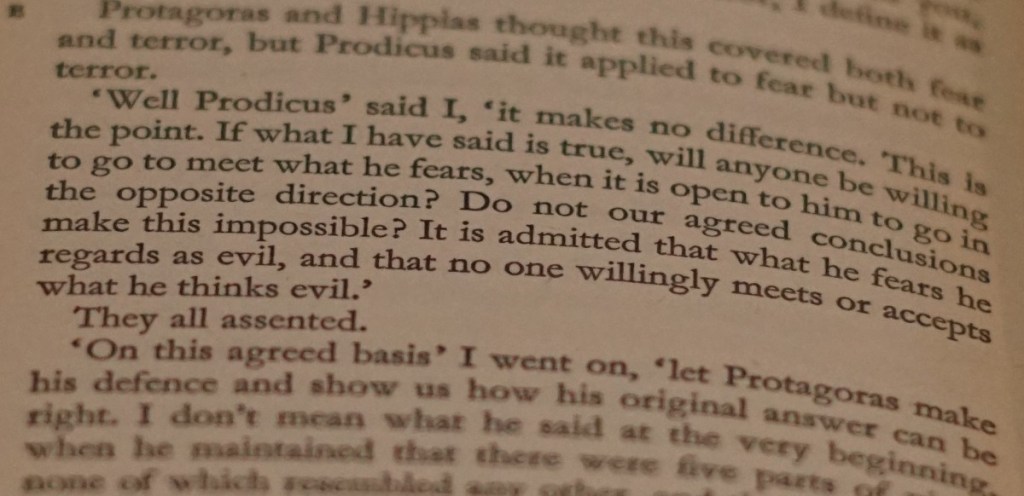
Read superficially, the Protagoras doesn’t appear to tell us much of any use that isn’t told better elsewhere – unlike the Meno, which has some more memorable features – so if you’re teaching (or learning) an introductory course on Plato, you might be inclined to skip this one altogether. That would be a shame, because it’s another excellent example of Plato’s ‘writing with layered intentions’; and if you can uncover the meaning in the Protagoras, you will be well-equipped to discover more meaning in the other Platonic dialogues. […]
-
The Problem of Morally-Impossible Evil
Philosophers will say that there is no essential inconsistency in the so-called ‘inconsistent triad’ of the problem of evil: God is good, God is powerful, evil exists. Perhaps they are right, if we are talking about physical or metaphysical necessity. But if we are talking about moral necessity, I think they are wrong. […]
-
Sketch of a Theodicy
This is a sketch of a theodicy: an attempt to solve the problem of evil by offering a justification of God’s permission of evil. It is only a sketch: you will have to go and consult the literature to find these theodicies fully and better expressed in all their glorious technical detail. We are asking why a good God allows bad things to happen. There are classically two answers to this question: a) It’s good for us, and/or b) it’s our fault. […]

An experiment with philosophy as a way of life
 tobybetenson.com