-
On Being Someone Who Has Something To Say
Being ‘someone who has something to say’ is a pre-requisite for any serious discussion. Without it, there’s a danger that anything said might be ‘mere words’. When Plato explains this requirement, he describes it as a harmony between logos and bios: your words align with your actions; your understanding is shown in your way of life. You say what you are and you are what you say. When there’s a disharmony in these things, it undermines what you say and, more importantly, who you are to say it.
-
Believed by the Wise: Socrates, Pragmatic Arguments, and Pascal’s Wager

I’ve been wrestling with an aphorism that I can’t pin down. I want to say this: ‘The wise believe what is good and true, the clever only what is proven.’ But I can’t. The tone may be right, but the content is wrong: or rather, not wrong but factually inaccurate.
-
The Protagoras: How To See What Isn’t Said
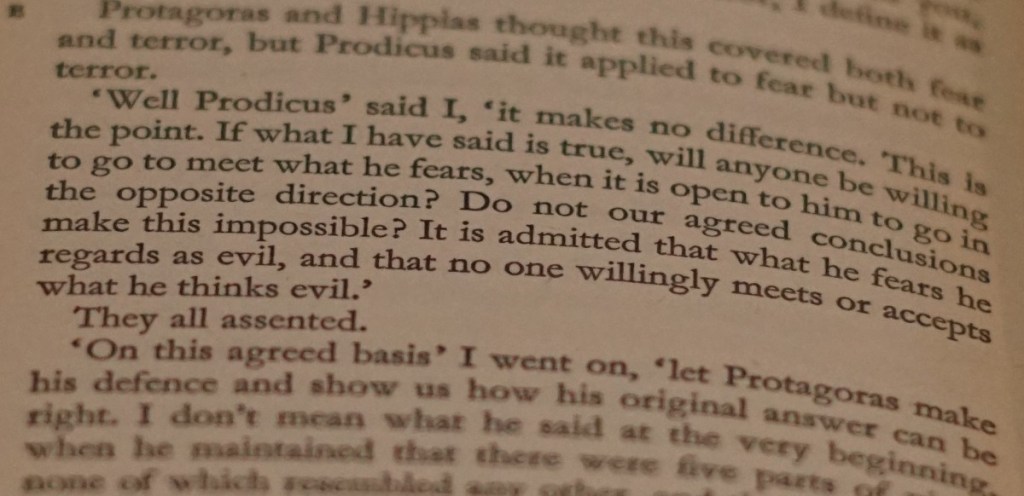
Read superficially, the Protagoras doesn’t appear to tell us much of any use that isn’t told better elsewhere – unlike the Meno, which has some more memorable features – so if you’re teaching (or learning) an introductory course on Plato, you might be inclined to skip this one altogether. That would be a shame, because it’s another excellent example of Plato’s ‘writing with layered intentions’; and if you can uncover the meaning in the Protagoras, you will be well-equipped to discover more meaning in the other Platonic dialogues. […]
-
The Meno: How to See What Isn’t Said
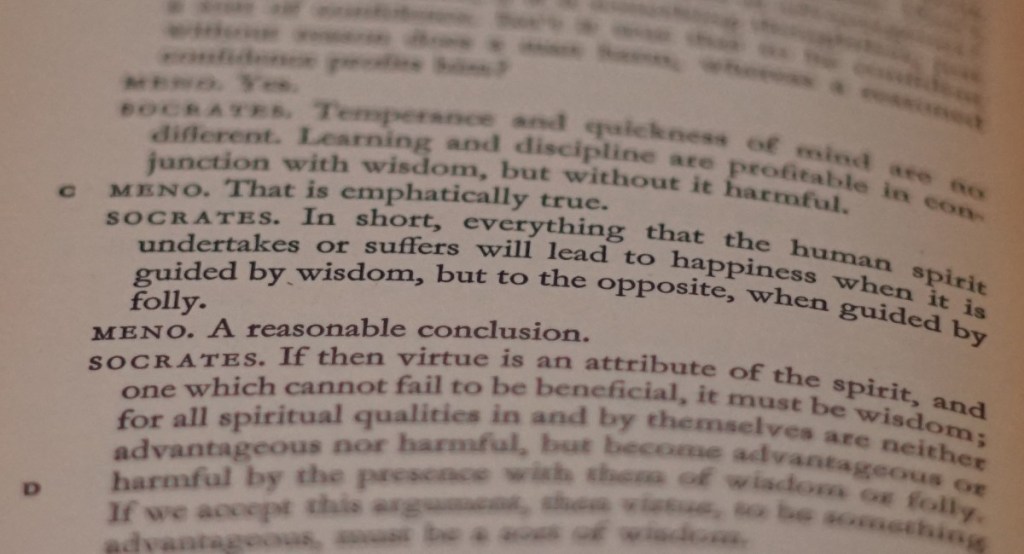
The Meno is one of the most complicated yet clear examples of Plato’s way of ‘showing one thing whilst saying something else’. Elsewhere I’ve described this as writing with layered intentions: on the surface there are some philosophical arguments with which you may or may not agree; beneath that there is a show of doing philosophy in a certain way; and beneath that there is a provocation to do it yourself. What’s on the surface isn’t really what the dialogue is about. […]
-
How To Read Plato

Academic philosophy ought to be teaching this but unfortunately it has become shallow and stupid. Or perhaps it thinks that students have become shallow and stupid and are only capable of understanding superficial arguments. Either way, it neglects what really matters, and too much is lost in that. When reading any of Plato’s dialogues, to understand them properly you need to remember these three things […]

An experiment with philosophy as a way of life
 tobybetenson.com