-
Plato’s Dualism and the Priority of the Intelligible World

What is philosophy, when it’s not Socrates asking a lot of questions? It is the exercise of reason. We apply our intellectual powers to a problem and try to think it through. Plato, a student of Socrates, slowly moves into this realm of pure thinking. This shift in emphasis leads Plato to make an important discovery: there is a world that we see with our eyes and a world that we see with our minds. […]
-
Plato’s Tripartite Soul
Reflect on yourself: your personality, your desires, your actions and thoughts, your body, whatever you care to think of as being something that makes you what you are. Do you find it to be in unified agreement, pushing you in the one same direction, or do you find it to be in disagreement, pulling you in different directions at one time or another or even at the same time? For me, as I suspect would be true for many people, it is the latter. […]
-
Happiness, According to Aristotle
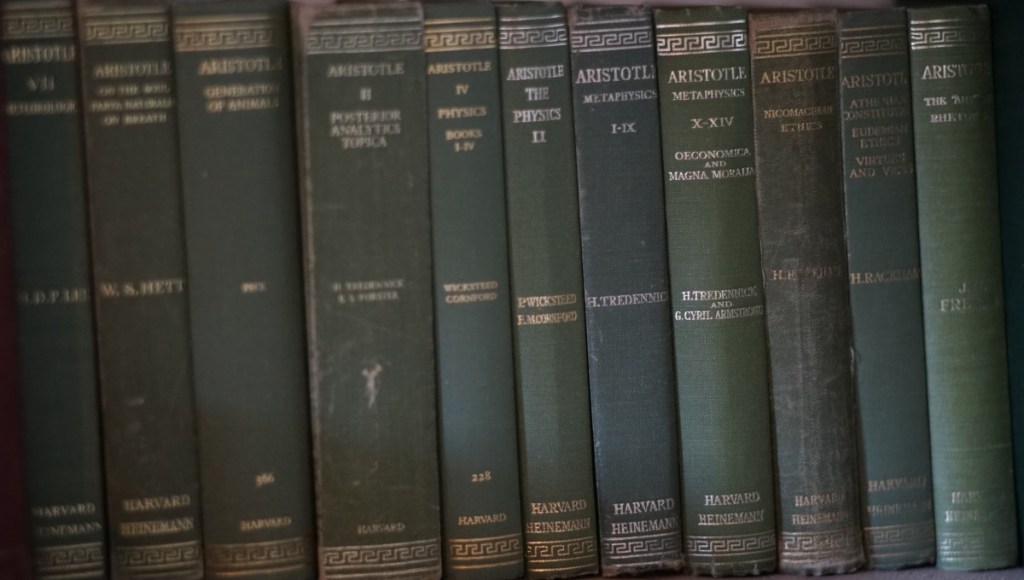
If everything we do, we do for the sake of happiness, what is happiness? What is it to live well? What is it we are aiming for? Aristotle’s answer here depends on his metaphysical categories. That’s enough to put some people off. But even if we are not on board with his metaphysical reasoning, the answer he gives is profoundly insightful and has been tremendously influential. It’s very much worth some serious consideration. […]
-
Aristotle’s Theory of Causation
What is it for something to ‘cause’ something else? This is a very difficult question to answer. No science or philosophy has yet really settled the question, in fact, and it remains a topic of serious debate now and for the future. We will leave that debate for the metaphysicians and focus on Aristotle’s version. […]
-
A Very Brief Introduction to Aristotle’s Metaphysics
Aristotle was a very down-to-earth philosopher. He said we should trust observation over theory, and trust theory only if it matches up with the observable world. If you want to understand something, look first, think after. That might be a good slogan for Aristotle’s approach. So what do we see when we look at the world? […]

An experiment with philosophy as a way of life
 tobybetenson.com