-
The Rion: An Ancient Dialogue for Our Times
The Exile: Very nice to meet you, Rion. Am I talking to you at home? Rion: No, I’m in a hotel just outside of Bullton right now; I’ve been here to give a talk at a conference on mental health. Ex: And did they have many philosophers talking at the conference? Ri: Oh for sure, quite a lot, and lots of other writers and YouTubers. Ex: And how do you think your talk went down? Ri: It was a sell out! And it was live-streamed; mine had the most hits and likes of all of the talks. Ex: Congratulations! Presumably…
-
Why Do I Write?

Why do I write? When I say write I mean writing philosophy. I could try writing other things, I suppose, but what I have been writing up to now is philosophy. And not only writing it but also putting it online for all to see. What is the purpose of this? […]
-
Diogenes the Cynic

Diogenes sees a mouse, happily running about, not looking for money or prestige, and finds a lesson in the mouse’s behaviour: Nature has given us a relatively easy life, but we’ve overlaid it with nonsense. We make life difficult for ourselves by wanting more than our nature needs. Diogenes implores us to realise this, offering us a walking talking living breathing lesson with his own example. […]
-
Plato’s Dualism and the Priority of the Intelligible World
What is philosophy, when it’s not Socrates asking a lot of questions? It is the exercise of reason. We apply our intellectual powers to a problem and try to think it through. Plato, a student of Socrates, slowly moves into this realm of pure thinking. This shift in emphasis leads Plato to make an important discovery: there is a world that we see with our eyes and a world that we see with our minds. […]
-
Two Philosophical Approaches

Two approaches have been pre-eminently influential in philosophy. One approach says that we should trust what we think over what we see, because our perception is unreliable: we should place ‘mind over matter’. The other approach says that we should trust what we see over what we think, because our thinking is unreliable: we should place ‘matter over mind’. Both approaches have consequences, good and bad. […]
-
Plato’s Tripartite Soul
Reflect on yourself: your personality, your desires, your actions and thoughts, your body, whatever you care to think of as being something that makes you what you are. Do you find it to be in unified agreement, pushing you in the one same direction, or do you find it to be in disagreement, pulling you in different directions at one time or another or even at the same time? For me, as I suspect would be true for many people, it is the latter. […]
-
Plato’s Political Philosophy
It might sound odd to say that Plato’s discussion of political philosophy shows us important truths about how to live well. For many of us, thinking about politics is likely to make us feel more anxious and depressed, not less. But it makes more sense when you consider why Plato is discussing political philosophy in the first place. […]
-
A Very Brief Introduction to Aristotle’s Metaphysics

Aristotle was a very down-to-earth philosopher. He said we should trust observation over theory, and trust theory only if it matches up with the observable world. If you want to understand something, look first, think after. That might be a good slogan for Aristotle’s approach. So what do we see when we look at the world? […]
-
Pandering
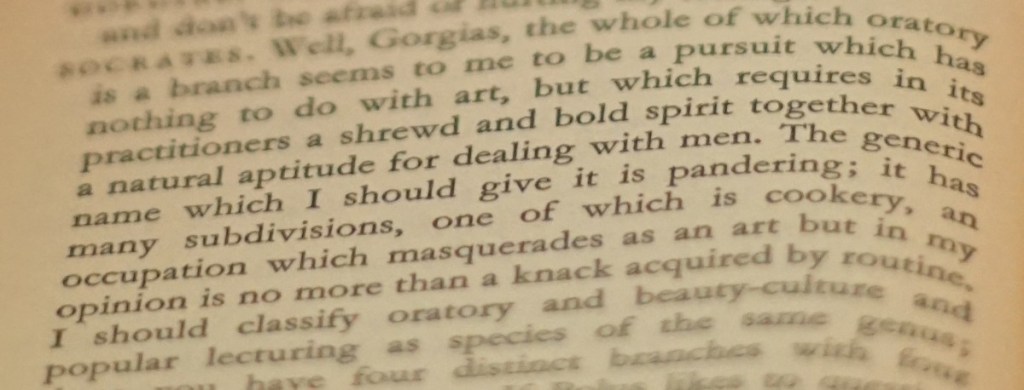
Recently, I’ve been running a series of posts about the problem of evil. Much of it is recycled from my book on the subject. The main motivation for this is SEO: I want to teach the Google bots that my writing here is what should be read, rather than my old academic writing. Ancient Greek philosophers had a word for this kind of thing: κολακεία. It is variously translated as ‘pandering’ or ‘flattery’. It means playing to the crowd. In my case, it means trying to give the Google bots what they can understand. […]
-
The Protagoras: How To See What Isn’t Said
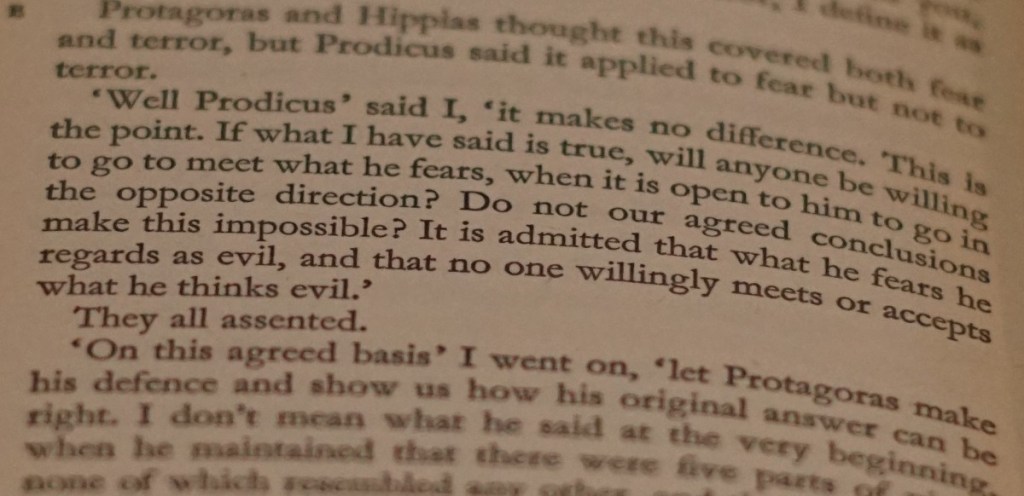
Read superficially, the Protagoras doesn’t appear to tell us much of any use that isn’t told better elsewhere – unlike the Meno, which has some more memorable features – so if you’re teaching (or learning) an introductory course on Plato, you might be inclined to skip this one altogether. That would be a shame, because it’s another excellent example of Plato’s ‘writing with layered intentions’; and if you can uncover the meaning in the Protagoras, you will be well-equipped to discover more meaning in the other Platonic dialogues. […]

An experiment with philosophy as a way of life
 tobybetenson.com