-
The Protagoras: How To See What Isn’t Said
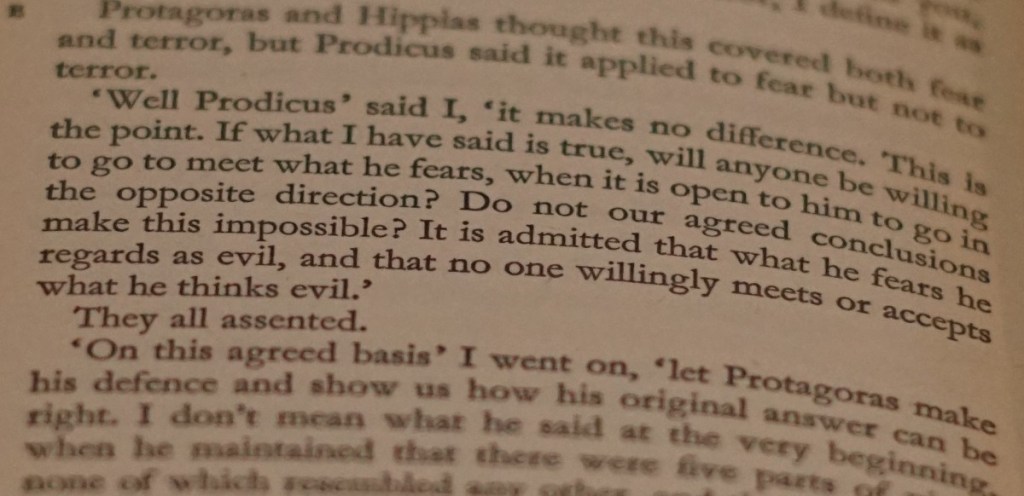
Read superficially, the Protagoras doesn’t appear to tell us much of any use that isn’t told better elsewhere – unlike the Meno, which has some more memorable features – so if you’re teaching (or learning) an introductory course on Plato, you might be inclined to skip this one altogether. That would be a shame, because it’s another excellent example of Plato’s ‘writing with layered intentions’; and if you can uncover the meaning in the Protagoras, you will be well-equipped to discover more meaning in the other Platonic dialogues. […]
-
The Meno: How to See What Isn’t Said
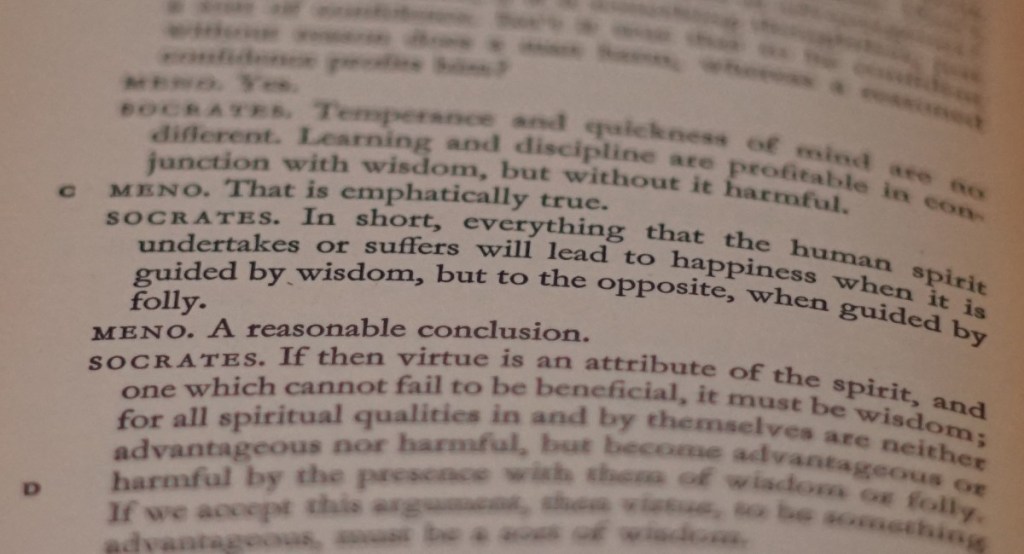
The Meno is one of the most complicated yet clear examples of Plato’s way of ‘showing one thing whilst saying something else’. Elsewhere I’ve described this as writing with layered intentions: on the surface there are some philosophical arguments with which you may or may not agree; beneath that there is a show of doing philosophy in a certain way; and beneath that there is a provocation to do it yourself. What’s on the surface isn’t really what the dialogue is about. […]
-
How To Read Plato

Academic philosophy ought to be teaching this but unfortunately it has become shallow and stupid. Or perhaps it thinks that students have become shallow and stupid and are only capable of understanding superficial arguments. Either way, it neglects what really matters, and too much is lost in that. When reading any of Plato’s dialogues, to understand them properly you need to remember these three things […]
-
The Allegory of the Cave in Plato’s Republic

In Plato’s Republic, Socrates paints a strange picture. Imagine a cave, underground (as caves are), with no natural light. In this cave are people chained up and chained down; they can’t move a muscle, not even their heads from left to right, and they’ve been stuck like that forever. They’ve never known any different. They are stuck in a dark cave looking at the wall directly in front of them. On this wall are shadows cast from a fire behind them. Between the fire and the people and the wall is a little runway with a kind of shadow-puppet theatre.…
-
It’s not about the gods: The Euthyphro
Socrates talks to a lot of different people about a lot of different things. In each case, Socrates meets people where they are, on their terms, and tries to move them one step closer to a better understanding. Mostly this movement is towards a better understanding of goodness and ethical excellence, regardless of the subject matter at hand. If you want to understand Socrates, understand this: It doesn’t really matter what they are talking about, Socrates is talking about virtue. A clear example of this is what we see in the Euthyphro. Socrates is talking to Euthyphro, who is busy…
-
The Plan of Life: The Timaeus
Everything makes more sense when you look at the plans. Like assembling flat-packed furniture. Open the box and it looks, at least to the untrained eye, like chaos that makes no sense. You study the parts and see no meaning in them. But study the plans and now you can see that this particular shape is the front of a drawer, these the sides, these the runners, etc. You follow the instructions and try to make it look like the image on the box. The plans enable you to build order from chaos. A trained eye can see things differently.…
-
Relationship Advice from Socrates: The Phaedrus
The Phaedrus is an outstanding example of a Platonic dialogue. It is really a dialogue about the dangers of trying to achieve philosophical understanding through listening to (or giving) grand rhetorical speeches or writing extended philosophical theses in essays or books. Socrates is predictably sceptical about these methods. They are far removed from the ideals of Socratic conversation. In speeches and writing, the truth is liable to distortion. The speechmaker or author gets carried away with rhetoric and style, prone to telling the audience only what will impress or flatter them, with the audience only hearing what they want to…
-
How to Die Well: The Phaedo
What is the Phaedo? Most summaries will say that it is a dialogue about the immortality of the soul. In it you will find some arguments for and against this claim (mainly for). Whilst dying, Socrates argues that he is not dying but only being separated from his body. His body is dying, for sure, but he is not his body: he is his soul and the soul cannot die. Or so he says. What does the Phaedo show? It shows Socrates dying and dying well. He is calm, serene, even cheery. He does not hesitate to take the poison.…
-
Ask the Right Question: The Laches
Socrates is always asking questions. But not just any questions: he wants to ask the right questions. Understanding which, of all the questions, is the right question, and how to ask that question in the right way, is one of the most important things you can learn from philosophy. If you ask the wrong question you will always get the wrong answer.

An experiment with philosophy as a way of life
 tobybetenson.com