-
Two Philosophical Approaches

Two approaches have been pre-eminently influential in philosophy. One approach says that we should trust what we think over what we see, because our perception is unreliable: we should place ‘mind over matter’. The other approach says that we should trust what we see over what we think, because our thinking is unreliable: we should place ‘matter over mind’. Both approaches have consequences, good and bad. […]
-
Relative Moral Certainty

Many judgements about the morally impossible will remain epistemically ambiguous and subject to change over time. Many philosophers who do not share my metaethical perspective will think this is a problem for any claims about moral necessity. But I think the issue of epistemic ambiguity actually reinforces my point, rather than weakening it, because this epistemic ambiguity is always relative to something more certain. […]
-
Plato’s Political Philosophy

It might sound odd to say that Plato’s discussion of political philosophy shows us important truths about how to live well. For many of us, thinking about politics is likely to make us feel more anxious and depressed, not less. But it makes more sense when you consider why Plato is discussing political philosophy in the first place. […]
-
Translation Matters: The Happiness of Stoicism
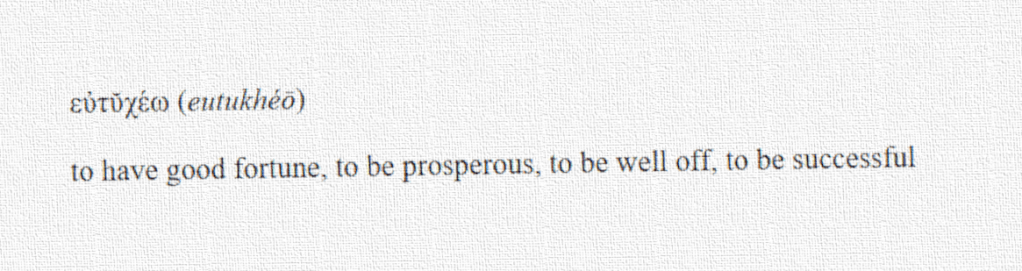
The meaning of the word ‘happiness’ has never been straightforward. Most of us aren’t clear what it means in our own language, let alone what it meant in an ancient one. This makes translation difficult. Most widely-available translations of ancient Stoic works think it easier to just say ‘happy’ and trust that people will understand more or less the right thing by that. But I think it’s an important word, and I’m not sure ‘happy’ is good enough. […]
-
Pandering
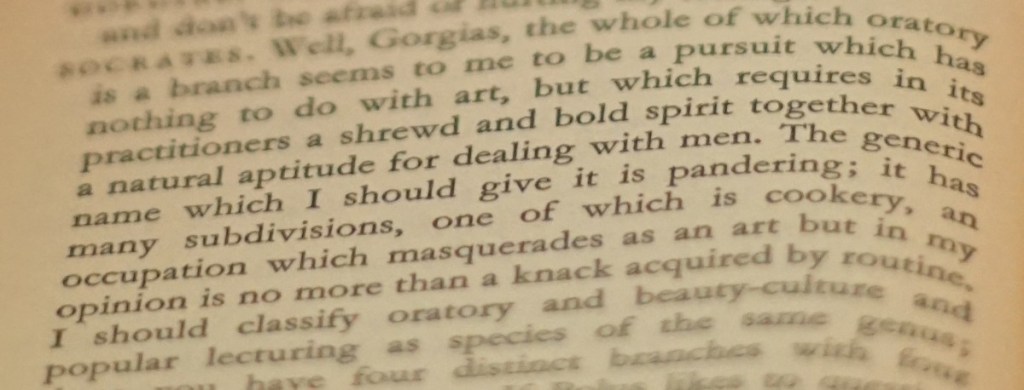
Recently, I’ve been running a series of posts about the problem of evil. Much of it is recycled from my book on the subject. The main motivation for this is SEO: I want to teach the Google bots that my writing here is what should be read, rather than my old academic writing. Ancient Greek philosophers had a word for this kind of thing: κολακεία. It is variously translated as ‘pandering’ or ‘flattery’. It means playing to the crowd. In my case, it means trying to give the Google bots what they can understand. […]
-
Evaluative Claims within the Problem of Evil

When it comes to the problem of evil, I’ve always felt there was something wrong with someone trying to argue for a factual conclusion on the basis of moral premises. Saying ‘God does not exist’ sounds an awful lot like a statement of a fact, like a claim that ‘no human being that exists is over 10ft tall’, but the grounds for this fact are at times little more than a report of your moral feelings. Ordinarily, we wouldn’t give this kind of argument the time of day. […]
-
The Protagoras: How To See What Isn’t Said
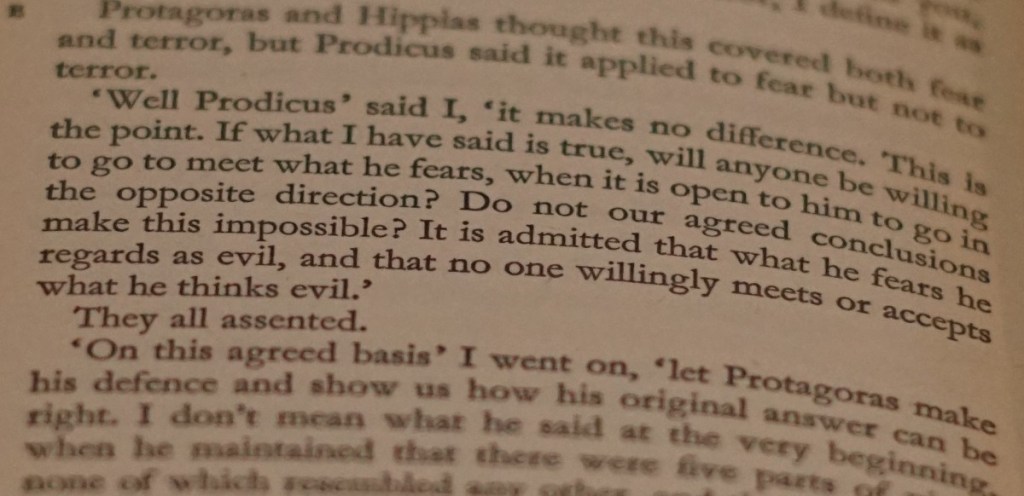
Read superficially, the Protagoras doesn’t appear to tell us much of any use that isn’t told better elsewhere – unlike the Meno, which has some more memorable features – so if you’re teaching (or learning) an introductory course on Plato, you might be inclined to skip this one altogether. That would be a shame, because it’s another excellent example of Plato’s ‘writing with layered intentions’; and if you can uncover the meaning in the Protagoras, you will be well-equipped to discover more meaning in the other Platonic dialogues. […]
-
The Meno: How to See What Isn’t Said
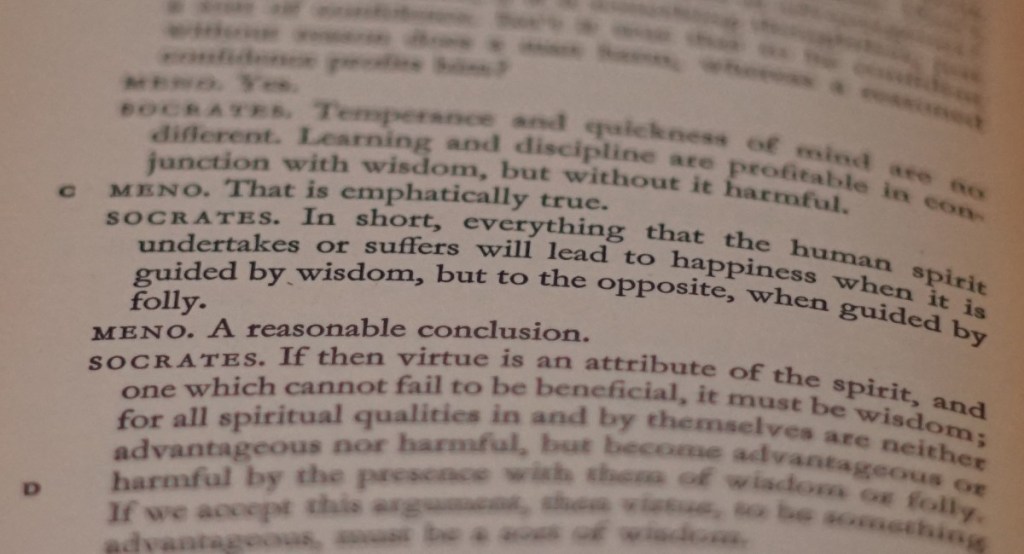
The Meno is one of the most complicated yet clear examples of Plato’s way of ‘showing one thing whilst saying something else’. Elsewhere I’ve described this as writing with layered intentions: on the surface there are some philosophical arguments with which you may or may not agree; beneath that there is a show of doing philosophy in a certain way; and beneath that there is a provocation to do it yourself. What’s on the surface isn’t really what the dialogue is about. […]
-
How To Read Plato
Academic philosophy ought to be teaching this but unfortunately it has become shallow and stupid. Or perhaps it thinks that students have become shallow and stupid and are only capable of understanding superficial arguments. Either way, it neglects what really matters, and too much is lost in that. When reading any of Plato’s dialogues, to understand them properly you need to remember these three things […]
-
The Value of Everything Depends on Ethical Goodness

Socrates says that virtue can make bad things good, whilst vice only makes good things bad. On the basis of this, he claims that virtue is sufficient for a good life. Socrates’ claim is very challenging. It’s often laughed at by his interlocutors, as if it’s expressing a kind of simple-minded childlike innocence, not worthy of a grown up. It’s too easy for us to take the same attitude. It’s too easy to dismiss Socrates as a kind of arch moraliser, telling us to ‘be good’ from a place of idle words. This would miss Socrates’ point entirely. Socrates isn’t…

An experiment with philosophy as a way of life
 tobybetenson.com