-
Antisthenes: Founder of the Cynic School of Thought
Antisthenes said he would rather go mad than experience pleasure. That is clearly hyperbolic, but it captures the more austere Socratic approach that can be seen in the early days of Cynic philosophy. […]
-
Aristotle’s Happy Middle

Look around you, and have a think, and draw up a list of qualities that some people have that you admire or appreciate. What comes to mind? It’s not for Aristotle (or me) to list the virtues, nor identify their purposes, because you can do this for yourself based on your own observations and reflections. What Aristotle points out is that virtues are very important, but you can have too much of a good thing. […]
-
Plato’s Political Philosophy
It might sound odd to say that Plato’s discussion of political philosophy shows us important truths about how to live well. For many of us, thinking about politics is likely to make us feel more anxious and depressed, not less. But it makes more sense when you consider why Plato is discussing political philosophy in the first place. […]
-
The Protagoras: How To See What Isn’t Said
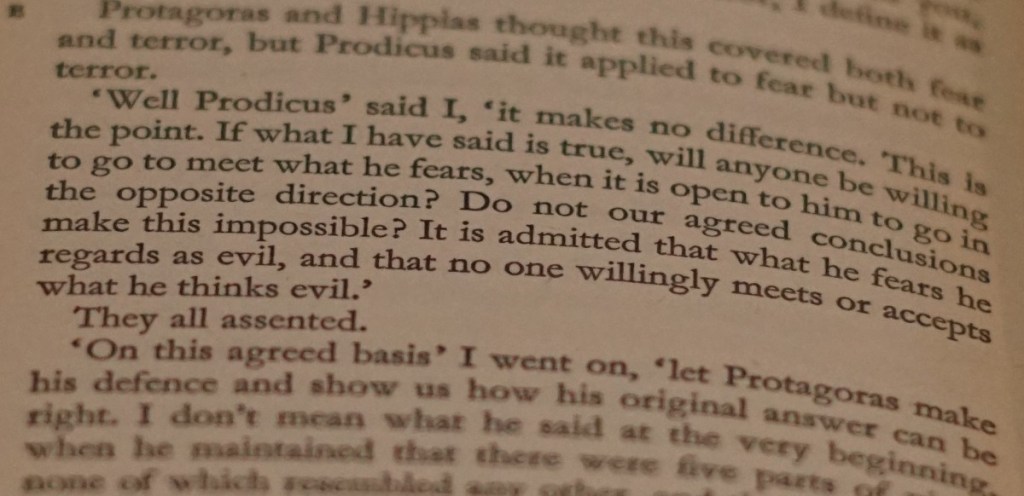
Read superficially, the Protagoras doesn’t appear to tell us much of any use that isn’t told better elsewhere – unlike the Meno, which has some more memorable features – so if you’re teaching (or learning) an introductory course on Plato, you might be inclined to skip this one altogether. That would be a shame, because it’s another excellent example of Plato’s ‘writing with layered intentions’; and if you can uncover the meaning in the Protagoras, you will be well-equipped to discover more meaning in the other Platonic dialogues. […]
-
Sketch of a Theodicy
This is a sketch of a theodicy: an attempt to solve the problem of evil by offering a justification of God’s permission of evil. It is only a sketch: you will have to go and consult the literature to find these theodicies fully and better expressed in all their glorious technical detail. We are asking why a good God allows bad things to happen. There are classically two answers to this question: a) It’s good for us, and/or b) it’s our fault. […]
-
The Meno: How to See What Isn’t Said
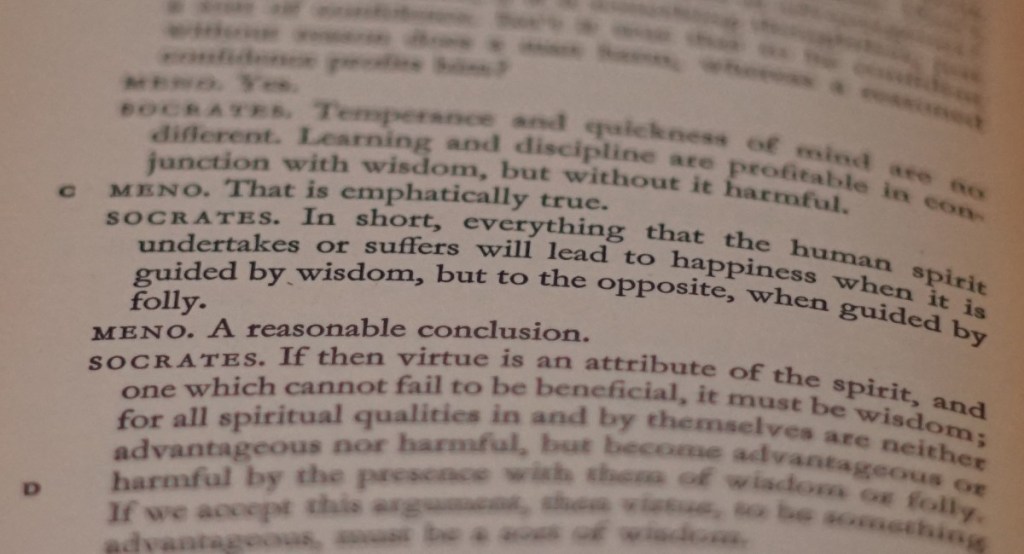
The Meno is one of the most complicated yet clear examples of Plato’s way of ‘showing one thing whilst saying something else’. Elsewhere I’ve described this as writing with layered intentions: on the surface there are some philosophical arguments with which you may or may not agree; beneath that there is a show of doing philosophy in a certain way; and beneath that there is a provocation to do it yourself. What’s on the surface isn’t really what the dialogue is about. […]
-
The Value of Everything Depends on Ethical Goodness

Socrates says that virtue can make bad things good, whilst vice only makes good things bad. On the basis of this, he claims that virtue is sufficient for a good life. Socrates’ claim is very challenging. It’s often laughed at by his interlocutors, as if it’s expressing a kind of simple-minded childlike innocence, not worthy of a grown up. It’s too easy for us to take the same attitude. It’s too easy to dismiss Socrates as a kind of arch moraliser, telling us to ‘be good’ from a place of idle words. This would miss Socrates’ point entirely. Socrates isn’t…
-
What is a Good Life?

This is a difficult question. To answer it, you need to make sure you’re asking the right question in the right way. Consider any part of what you might traditionally (or stereotypically) think of as being essential to living a good life: wealth, property, success, family, love, confidence, popularity, freedom, power, status, productivity, etc., etc. These are the things that most people aim for […]
-
Good Enough
I am convinced that virtue is necessary for happiness. I am not convinced that it’s sufficient. But knowing that it is necessary to be good is good enough for me.
-
Shadow Chasing
Over the past few years – having made an attempt to pursue philosophy as a way of life, to take it seriously and digest its lessons and not only treat it as an academic discipline – I’ve come to see new depths in old ideas. One example of this is the cynical little detail in Plato’s ‘Allegory of the Cave’. There, Plato suggests that these poor souls – imprisoned in a dark cave of ignorance and only able to look at the shadows on the wall in front of them – would esteem those who are best at discerning the…

An experiment with philosophy as a way of life
 tobybetenson.com