
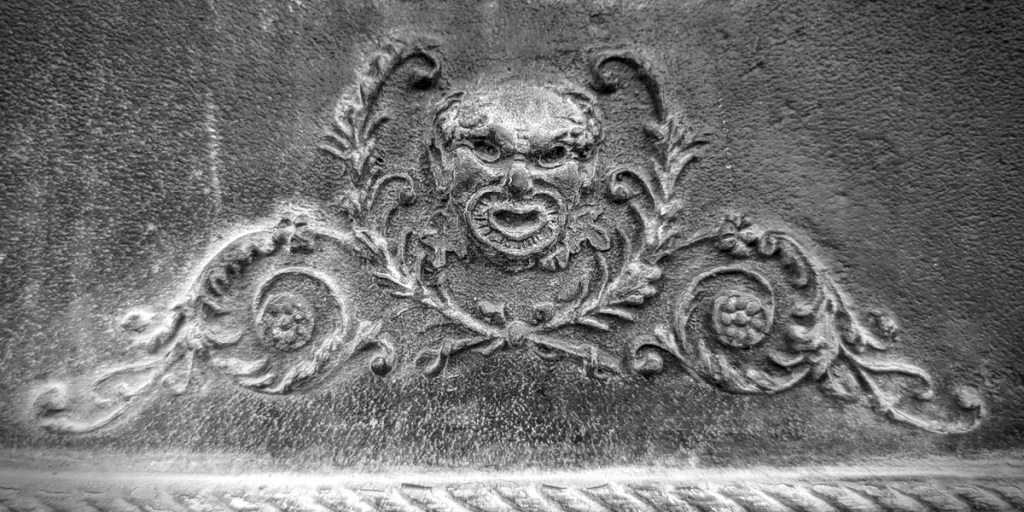
I saw a strange play the other day. I’m still not sure what to make of it. It didn’t make much sense to me, but maybe it can make some sense to you?
In the first act, a player strutted onto the stage in full costume, wearing a grotesque and elaborate mask. He said ‘I am a demon’ and launched into so many angry tirades against society. He accused everyone of being guilty of living in contradiction with themselves, denouncing the rich as poor, the powerful as weak, the knowledgeable as ignorant, and the beautiful as ugly. He said the happy are unhappy.
No one was spared from his criticism, he even picked on members of the audience, but he showed special contempt for the highest in society. There were a few topical shots against our current political leaders: these lacked finesse and seemed to have been ad-libbed.
This angry ranting went on for some time and to my mind it got tiresome. The rest of the audience got a bit restless too. Obviously the writer was trying to make some kind of point. Even so, shouldn’t the theatre be more than just a platform to make a statement? People gave up their time and paid good money to be here, after all.
It wasn’t initially clear to me why it was relevant that this character was a ‘demon’ but it became clear when he turned his tirade towards God. He concluded his little act by telling a tale about his fall from the heavens. Once he was an angel, he said, and he frolicked (his word) with the divine. But then he began to notice all these little inconsistencies: that those who seemed to be rewarded in the human world were rarely those who deserved any reward and that those who seemed to be punished were not often worthy of punishment. Little children were condemned to sickness and suffering whilst hate-filled warmongers lived long healthy lives in prosperity. Those who did worthless work were granted outrageous wealth and esteemed lives of ease and leisure, whilst those who worked at something worthwhile were given very little beyond the work itself. When the demon questioned why this was so, he was corrected and put in his place: who was he to question such things, being only a minor divinity?
At this point in the play, late in the first act, there was a very long pause. It was uncomfortable. The player stared out at the audience, looking as if at each person in it, though of course he couldn’t have seen us because of the bright stage lights and the comparative darkness of the auditorium. The pause went on so long that you started to think he might have forgotten his lines. In the end it wasn’t words that broke the silence, but music. Heavy and discordant, it rose from a barely audible hum to a raging crescendo, at which point the player gestured as if to smash something to the ground. ‘Enough!’, he shouted, and promptly walked off stage.
The effect was entirely unsubtle and struck me as quite childish.
There was then a very brief interval: literally an interval, in that the auditorium lights came up and the ice-cream sellers came down. But since the play hadn’t been going on very long the audience didn’t know how to react, and in any case as soon as the ice-cream sellers had taken their positions they just as quickly left them, having sold no ice cream. The lights went down and the second act started.
On came the player again, this time wearing lovely flowing robes of white and a mask that seemed to represent the picture of health and beauty. ‘I am an angel’, he said, a little too softly for the space of the stage. His voice was calm, his movements serene, showing no trace of the anger of the first act. He said that he was not a god but he was like a god. He said, eyes turned upwards, that he has seen the gods and has seen that they are perfectly pleased, untroubled by the affairs of men. He turned to the audience and told us that we too can be like the gods if we free ourselves from what troubles us. He said we can do this, not by freeing ourselves from the things that trouble us, but by freeing ourselves from the trouble that things cause us. He told us that the gods have given us everything that we need to achieve this, as he has, because we share with them a piece of the divine. He said this was our capacity for rational thought. It is this divine spark that makes us what we are; it is this that makes us more than beasts. All we need to do to harness this divine power is turn our attention to it and cultivate it. Plant it, like a seed; nurture it, like a plant, and let it grow. Let it see the light of day and it will grow naturally. First a shoot, then a sapling: look after the tree and the fruit will take care of itself.
On and on it went. It sounded like a sermon to me and far too preachy. The theatre is not a church and neither is it the proper time or place for moralizing. Besides which, this flow of goodness and hope stood in such stark contrast to the dark and sceptical cynicism of the first act that you would’ve thought that anyone who enjoyed that would’ve seen nothing to like in this, and vice versa.
I soon lost interest. My attention wandered. The audience seemed bored. The only thing that regained our attention was the conclusion of the act. The player was still going on about something-or-other, but instead of concluding in a satisfactory way, he trailed off mid-sentence, as if he’d lost interest in what he was saying (as we had). There was now another long pause, like in the first act, just long enough to make you think that the player had forgotten his lines, but instead of the dramatic rise of music that signalled the conclusion then, the player seemed only to sigh quietly. He reached up and took off his mask, to reveal his face, which was made up to look like the demonic mask of the first act, twisted in anger and disdain.
It got our attention. We all sat there waiting for some of that mad energy that was at least engaging and occasionally entertaining. But it didn’t come. He only walked off stage.
It seemed to me that this was a missed opportunity. Whoever had written this piece had given no thought for the pace and flow of the stage. The audience were made to feel bored just as they ought to have been engaged, and then roused only to be dropped into an interval. All in all, whatever was going on expected too much from an audience who were only looking for an evening’s entertainment.
This time there was a proper interval. The lights came up and the ice-cream sellers came down and we all had a chance to stretch our legs and talk about what we’d just seen. I overheard a few snippets of these conversations: everyone was as confused as I was. They had heard such good reviews about this play but so far had seen nothing to warrant that opinion. No one seemed to think they’d got their money’s worth.
The interval ended; the third act began. On came the player, this time dressed in casual clothes and without a trace of theatricality. He had no props apart from a mask in each hand: the two masks of the earlier acts. He said he was neither a demon nor an angel but only an actor. He placed one of these masks to his face and said ‘I am wearing a mask’. He said that this was a dramatic performance, and for the sake of that he performed dramatically. He proceeded to narrate everything that he was doing as he went about the stage. ‘I am moving smoothly’, he said. ‘I am looking at you’, he said. ‘I am reciting lines’, he said. ‘These lines were written for me by someone who is not here’, he said.
God it was dull. It was so dull it made you want to walk out of the theatre. He explained everything: the stage, the lights, the relative position of the audience, even the location of the theatre. Everything that ordinarily goes without saying was put to us literally, with no pedantic detail spared. ‘I wear a mask to portray a character’; ‘I speak loudly and clearly so as to be heard’; ‘my words are meant to communicate a meaning and to provoke an effect’.
It was like a lecture, and it had the effect of a lecture: by this time most of the audience – those that hadn’t already left (the theatre was becoming quite empty) – were on their phones or otherwise distracting themselves. The player continued regardless of their inattention.
It was then that I realised something odd was happening. Not on the stage, the proceedings of which continued to be completely dull, but in me. In finding myself looking around at the audience and noticing how uninterested they were, as the player went about their work, I came to look at the situation from a different perspective. I was no longer an audience member watching a theatrical performance, locked in that two-pointed straight line of one-way communication: I was looking at the performance as if from the third point of a triangle, seeing not only the player and the performance but also the relation of it to the audience. I felt that, in stepping back like this, I could see and so understand a little more about what was going on. And from this perspective, I felt I wanted to ask a question: what is going on?
Why was this player doing what they were doing? What was this play about? But the irony that here they were, literally telling me what they were doing, and still it didn’t seem to answer my questions. The literal description seemed to miss the point entirely, and yet it wasn’t clear that there was any clearer explanation to be had.
My mind wandered into these confusions and I got lost in them. I stopped paying any attention to the stage. Some time must have passed, I’m not sure how much, and I was sorry that I’d drifted away because by the time I’d returned my attention to the stage the player was saying some quite interesting things. He was saying things like ‘I am not telling the truth’. This was an odd thing to say, I thought, since on the one hand it went without saying: no actor is literally what they portray themselves to be. And yet on the other hand it ought to be false, since the theatre is meant to show us true things, to hold up a mirror to our nature and all that (isn’t it?).
Then he said ‘I am not actually wise, even though I recite lines of wisdom’, which was only stating the obvious, but then he said: ‘Wisdom is not in words. Words do not contain wisdom and wisdom cannot be captured in them. And yet, particular words communicated in particular ways at particular times to particular people can, on occasion, bring about wisdom.’
It was a clumsy phrase, I thought: so many particulars. But what it said seemed to me to be true.
I can’t remember how the play ended: I was lost in thought. At some point there was a light smattering of applause and the stage was empty.
I’m still not sure what to make of this strange play. The first act had some entertaining energy, but there’s only so much ranting you can take. The second act was too preachy to take seriously. And the third act was dull, there’s no denying that; and in a way, because of that, and because of the meticulous description of the workings of the stage, you lose any effect that the first two acts could have had.
All I would say is that I left feeling like I understood more about the theatre.
Plato, Republic, Book VII, Section 515a
Lastly, there are idols which have crept into men’s minds from the various dogmas of peculiar systems of philosophy, and also from the perverted rules of demonstration, and these we denominate idols of the theatre: for we regard all the systems of philosophy hitherto received or imagined, as so many plays brought out and performed, creating fictious and theatrical worlds. Nor do we speak only of the present systems, or of the philosophy and sects of the ancients, since numerous other plays of a similar nature can be still composed and made to agree with each other, the causes of the most opposite errors being generally the same.
Francis Bacon, Novum Organum, Book I, Aphorism XLIV
Related post: Why Do I Write?
 tobybetenson.com
3 responses to “A Strange Play”
[…] The purpose can only be to encourage people to embark on the study required to become pilots, so that they can find the good answers for themselves, or else become someone who might be able to help us in our search for good answers. We call this ‘protreptics’. We want people to become good pilots (philosophers), but we can’t do it for them. Perhaps as a part of this we might show people how we fly planes (do philosophy), and we might even talk with them about how we fly planes, but don’t pretend that this is a ‘discussion’. It’s only a show. […]
LikeLike
[…] is the line between irony and hypocrisy? The man who puts himself on a stage only to say ‘don’t listen to me’; or worse, the man who refuses to put himself on a stage, […]
LikeLike
[…] do I share these reflections? To make a dramatic example of myself. It is an attempt to shout above the choir. It is an attempt to show what isn’t said. But if you […]
LikeLike