
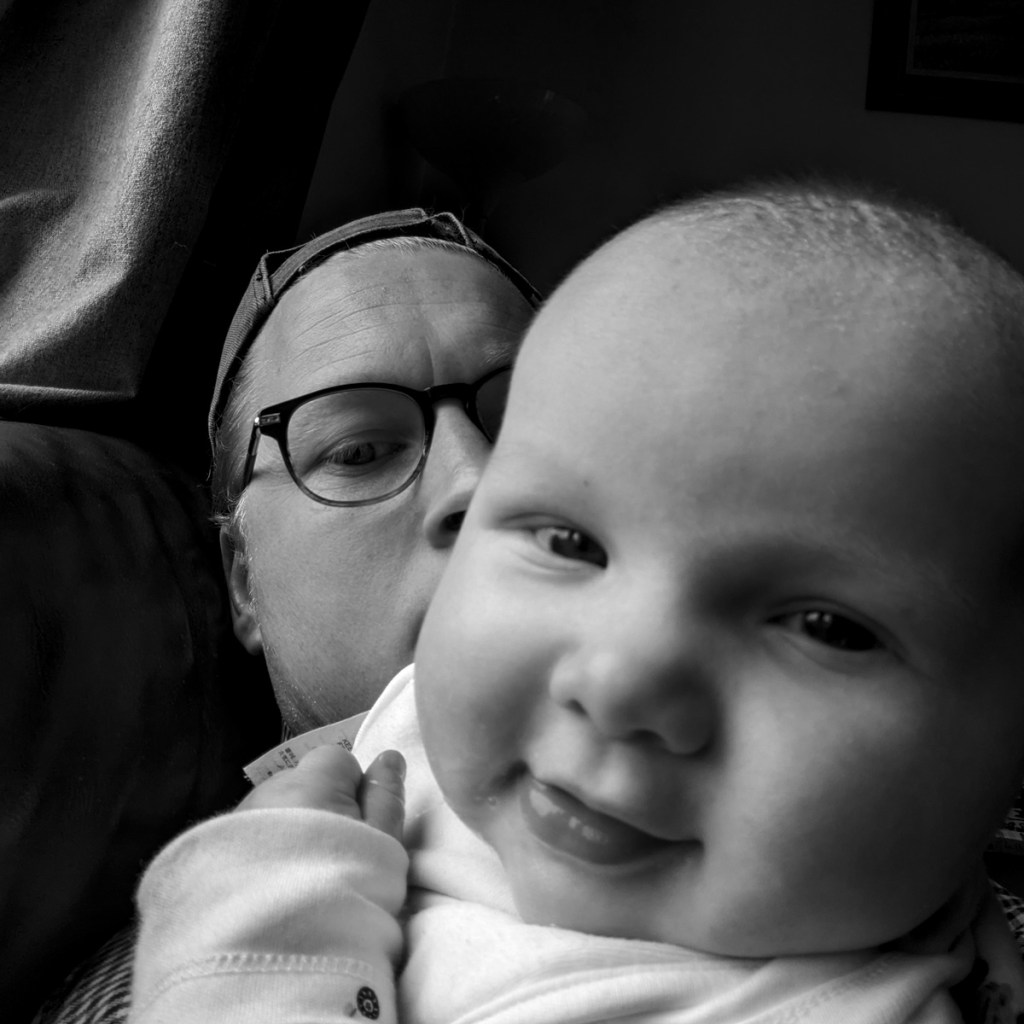
This was written some time ago and I’d binned it for good reason. It’s so whiny.
But then yesterday we had our daughter’s 30-month check up with the ‘health visitor’ (why do we still call them health ‘visitors’ when we always have to go to them?!) and, well, whiny or not, I think there’s something here worth saying.
Just a few quotes from yesterday’s visit:
‘What’s your name? We don’t tend to have dads on the system.’
‘You can ask your lovely wife if you need to.’ (As I fill out a questionnaire on our daughter’s daily habits; the presumption being that obviously I wouldn’t have a clue.)
‘Do you work?’ (Said to my wife.) ‘Part-time or full-time?’ (She works full time.)
(To me.) ‘And dad, what do you do for work?’ Put farmer; it’s simpler. ‘And that’s full-time obviously.’ (As she fills out the form without pausing to hear the answer.)
Part-time actually. ‘Oh, I just assumed there didn’t I?’ (She scribbles it out and writes again…)
We went through the whole meeting without her having the first idea that I was a ‘stay-at-home dad’. She didn’t ask, and I can no longer be bothered to make a point of it.
Because I’m not really troubled by all this anymore. The therapeutic benefits of philosophy and writing: I’ve worked it through. Perhaps it might do some good to show my working.
It might not trouble me (much), but it remains a thing that’s definitely out there, and I think it’s wrong. Society has a strange blind spot when it comes to primary-parent dads and it causes people to behave in thoughtless ways, ways that end up working against exactly what we wanted to encourage.
We want to encourage a more equitable share of the parenting load. We want dads to be more involved. Perhaps, then, you shouldn’t make dads feel so out of place, like there’s something wrong with them, for being so?
Act like it is normal and it will become normal; act like it is strange and it will remain strange. Abandon your lazy old stereotypes. Recognise the new generation of dads and acknowledge it. Or else don’t be surprised that nothing changes.
My occupation
‘There isn’t an option for what you do’, says the (male) financial advisor, ‘so I’ll just put unemployed.’
This was the conclusion to a muddled conversation that began with a straightforward question: ‘What is your occupation?’
What I am occupied with, and have been fully-occupied with since my wife returned to work, is looking after our 18 month old daughter.
What is the term I should use to describe this occupation? What is it that I do? What am I?
Full-time father? We call the others part-timers, then. That seems unfair.
Stay-at-home dad? I suppose I do stay at home but where else am I supposed to stay? Are there on-the-road dads? Resort-based dads? Is there an office I should be going to?
Homemaker? But I do not make homes; that is not my occupation. I care for a child, and I cook, and I keep things up together, but I am certainly not one of those people you would describe as ‘house proud’. I keep our heads above water is about the best you could say.
Househusband? The typing of which is met with the wavy red line of a spelling error; unlike housewife, which is not. Even the computer cannot conceive of a man doing what I do.
In conversation I find myself settling on ‘childcare’ or ‘caregiver’, because that is what I do: I give care. But who doesn’t?
I heard recently that the more and more popular term was ‘work-from-home dad’. I get it and I empathise, but I’m not sure I’m happy to go along with the trend. This term means that you are dadding all of the time, but clearly what you really do is work on various projects that actually count for something worthy of esteem.
Because dadding doesn’t count. It’s not worthy of esteem. Not like mothering, anyway. Mothers are understood to be burdened and overburdened with the responsibilities of childcare; they are trapped; they are isolated; they are undervalued and taken for granted. But when men say they are doing the work of a full-time parent, it’s assumed they are lying to themselves and others. Because it’s a known fact that men tend to over-represent what they do, domestically, and women tend to under-represent.
It’s not difficult to explain why so few men take on this role; relative to women, I mean. My brief experience has made it very obvious and I can and will list the reasons for you. Relative to women in the same situation: a man in this situation is less likely to be acknowledged, more likely to be condescended to, more likely to be dismissed if they complain, more likely to be isolated, more likely to be judged badly for taking on this role, more likely to be made to feel like he doesn’t belong.
In short, in contrast to women, a man in this situation is repeatedly made to feel like there is something wrong with him.
It’s not true, of course, but it can easily feel that way. And I’m sure it’s one of the main reasons why there remains such gender inequality in this issue.
Mothers should be celebrated for what they do, but so should fathers who are doing the same thing.
They are not.
A man in this situation is less likely to be acknowledged
It’s rare for people to acknowledge what I do, let alone the value of what I do. Instead, people are always asking me what else I do; for work, I mean, not leisure. I turn up, baby in sling on front, baby bag on back, and they ask: ‘what have you been doing with yourself then?’ And they aren’t joking; they aren’t being ironic (as I would be if I asked that kind of question to someone in that position).
Men and women alike cannot conceive of a man doing the work of a full-time parent. It makes no sense to them. When asked what I do, and I reply that I do full-time childcare, I know what comes next: ‘But what do you do for work?’
I respond with the various bits and pieces I happen to do on the side, when the baby is napping or being looked after by grandparents – farm work, writing, architectural drawing – and they are noticeably happier to talk on these terms.
‘Of course, you don’t really do full-time childcare; that’s just the sort of thing men say. What you are is a part-time something-or-other who picks up a little of the domestic burden because you haven’t succeeded in any of your various attempts at a career.’
The simpler answer, which is also the real answer, which is that I am a man doing the work of a full-time parent, simply doesn’t make sense. And people don’t like what doesn’t make sense – it makes them uncomfortable – so they keep asking questions until they find something that relieves their discomfort.
I had a particularly clear example of this some time ago. In a physio session, the third session with the same physio, the reason for which was a tendonitis commonly known as ‘mummy’s thumb’ and the cause of which had already been identified as the repetitive picking up and carrying of a child, the (female) physio asks if I work at a computer all day. It’s a strange sort of blind-spot. Would they ask the same question to a woman in that situation?
If they do accept that I am really doing full-time childcare, I’m invariably met with variations on the theme of ‘what’s wrong with you?’, such as being asked if I don’t work because of ill health. Would they ask a woman that question in this situation?
Whatever the context, what I do stands in need of explanation, and they are not happy and will not stop asking questions until they settle on a narrative that makes sense to them. Experience this incessant questioning for yourself and you will understand why I am left feeling like there must be something wrong with me.
A man in this situation is more likely to be condescended to
All of this questioning comes with a very particular tone of voice. It took me ages to put my finger on what particular tone of voice it is that I’m detecting. It’s that tone of voice that results when you talk to someone who thinks too much of themselves but doesn’t realise it. Like when you’re experienced or skilled in an activity, like a sport or playing a musical instrument, and you meet someone who isn’t but doesn’t realise it, perhaps because they’re a beginner, and they talk about what they know, which isn’t really much – like that joke about a guitarist asking ‘how many chords do you know?’ – and you smile and nod and say ‘oh really?’, but really you know they don’t have a clue. They’re making it up and they don’t know they’re making it up, but you do because you know better.
It’s that tone of voice. Thinly-veiled polite condescension; well-meaning but ultimately dismissive, and asserted from a position of absolute superiority that would be defended if challenged.
It’s not a perfect analogy, because most of the time I don’t claim to have the first idea about what I’m doing. I claim no expertise, at all; all I claim is that I am doing it. But their tone of voice (together with their questioning) indicates to me that they don’t really believe this. ‘Sure you are! But what do you really do?’
Experience this for yourself, be surrounded by this tone of voice, and you will understand why I am left feeling like there must be something wrong with me.
A man complaining in this situation is more likely to be dismissed
When I report this to women, they typically react in the same way that men used to react to women reporting sexism: which is to say that it is pooh-poohed. ‘You probably misinterpreted it.’ ‘They didn’t mean it.’ ‘You’re being too sensitive.’ Etc.
But when we visit the (female) healthcare visitor, and she directs her questions to my wife (only to my wife) about our daughter’s daily activities, and when she doesn’t know how to answer my wife turns to me, and I answer, again and again, and the healthcare visitor keeps directing questions to my wife, and round and round we go, the effect isn’t subtle. And on the way out of the door: ‘So do you do most of the childcare then? That’s a nice turnaround, I suppose, for the woman to go out and earn the money and the man to stay at home!’ And we laugh; although I’m not sure we’re laughing at the same thing.
Am I being laughed at? I don’t think so, but it’s not clear. But I have just been talked past for the past hour, as if anything I have to say is not relevant; as if I am not relevant. What are you doing here? Experience this for yourself and you will understand why I am left feeling like there must be something wrong with me.
A man in this situation is more likely to be isolated
I think a woman in this situation would be more likely to have female friends in the same situation and they would find support in that. I think if I had one male friend in the same situation, it would feel different. We would support each other. But my male friends are all working and consider me to be on a holiday.
Or if I didn’t have any friends in the same situation, I could make new friends because of the situation. Mums take this time to go to mums groups, but there are no dads groups; at least none within 50 miles of me.
Needless to say, because of the rarity of men doing this role, the parents and grandparents at the local toddler group are all women. They are polite, but it’s clear I am an oddity and a novelty. I’m not really ‘one of them’.
I am on my own. Everyone else doing what I do looks at me as if I am out of place. Experience this for yourself and you will understand why I am left feeling like there must be something wrong with me.
(Postscript: I wrote this a while ago. Since then, I’ve moved to a new toddler group and there was another dad there once (only once). It’s noticeable how different it felt: it only takes one other to make you feel like you aren’t completely out of place. Apart from the fact that your arrival is noteworthy in relation to this: ‘Oh, another one! You must meet [x]…’)
A man in this situation is more likely to be judged badly for taking on this role
To choose this life you have to abandon all esteem and respect, all ambition, all position and status, your money, your freedom, not to mention your social life and hobbies. Some of this is true for women too, but not all in the same way. As I’ve just mentioned, I know of no other men doing what I do, certainly none of my social circle: to sacrifice your social life means something different if many of your friends are going through a similar thing at a similar time, or if there are many opportunities to make new friends through this new thing that you’re doing. That would be the case for many women (see above) but it is rarely the case for men.
And as for ambition, position and status, money, freedom, and hobbies: men in particular have been taught, and are still told, to be ashamed to live a life that is lacking these things. What do you do?
Once upon a time this was different for women, but that is no longer the case. We all carry the baggage of the late-capitalist neo-liberal world that we’ve made for ourselves, which tells us that we should sacrifice everything at the altar of image and material success. Some women, however, are permitted a shame-free escape from the race into a domestic family life; for a certain period of time, at least. But no man is permitted more than his statutory period of paternity leave without incurring shame. If he does so, the question will be asked: why? What’s wrong with him?
Am I proud of what I do? I think I ought to be. But I’m not. Not publicly, anyway. I don’t take pride in it because I can’t take pride in it because I am not allowed to take pride in it: for me to take pride in it would be shameful, because it’s mostly made clear to me that I ought to be doing something else.
It’s the privilege of a philosopher to do well but be badly thought of. I know that people can only judge things as they seem to them. But I think they are wrong to think so little of what I do, as a man, when they would not think it right to think as much for a woman.
A man in this situation is more likely to be made to feel like he doesn’t belong
It starts with the midwives. They will make fun of you, as when in the hospital within the first 24 hours of our daughter’s birth, which had been very difficult and culminated in an emergency C-section, and my wife was passed out and recovering, and I had a milky-vomit stain on my shirt having fed my baby, I am mocked: ‘are you lactating too then?’ What are you doing here?
Or else, if they don’t make fun at your ‘token efforts’, they will see your involvement as a kind of overbearing oppression of the mother. They see you as somehow interfering with the mother-baby bond. And that makes sense: if you don’t think it’s a man’s place to be doing these tasks, because they are the mother’s tasks, then when a man steps in (though I’d rather say ‘steps up’) to do these tasks, how else can you perceive it except as an unwanted intervention? And why else would a man do such a thing, when it is not wanted, except to be controlling? What’s wrong with you?
Some of this is probably unavoidable because of breastfeeding: it’s clearly not my place to do that. But it seems to me that the general attitude to breastfeeding has an insidious effect. This isn’t really my place to point out, so I’ll talk by an analogy that trades on another classically patriarchal stereotype. Imagine you have a series of meetings with medical professionals, and in all of those meetings you are surrounded by positive images of fit and slim people, and constant reference is made to the facts of how much better it is to be fit and slim, and how much worse it is to not be fit and slim, and help and support is offered if you too want to do what is necessary to be fit and slim, and then after all that, after a certain point, they continually ask you: ‘how are your attempts to be fit and slim going?’ And if you say ‘not so well’ they say: ‘how can we help you to be fit and slim?’ And they will keep on and on… Wouldn’t you start to feel like you really ought to be fit and slim, and that there is something wrong with you if you are not fit and slim?
The obviousness of this kind of thing in all the ante-natal stuff irritated me, so I became a bit hostile to it. I could see the effect it was having on my wife – guilt and shame at the prospect of perhaps not being willing or able to breastfeed – so I felt naturally inclined to counter it, for her sake. I made it clear that, as far as I was concerned, either way was fine and good. (Because it is.)
As it happened, likely due to the difficult three-day labour and C-section, my wife did not take to breastfeeding. The midwives tried to do the first feed within minutes of leaving the operating theatre, when my wife was traumatised, extremely tired, barely conscious, and looking a pale shade of green. It didn’t go well. At this point I stated reassuring words to the effect of ‘don’t worry about it; get some rest; it doesn’t matter; you can try again later’ and at that last phrase the midwife turns to me with the dirtiest accusatory look and starts talking to my wife in hushed conspiratorial tones about how she doesn’t have to breastfeed and she shouldn’t be made to feel like she ought to. As if I was the one who was imposing that obligation on her! What’s wrong with you?!
And in the ante-natal classes, the NCT groups: it was made very clear to me that, in the early days, a dad’s job is to bring drinks and make sure the TV remote is within reach of the breastfeeding mother. When asked what a dad should do when a mother was breastfeeding, the answer was ‘everything else’. That is, everything not related to caring for the infant. It’s like an old Harry Enfield sketch: Men, know your limits!
In the eyes of all of these people, men are not caring and capable. Men are oppressive, clumsy, ignorant: it’s not men’s fault, it’s their nature. The best thing that men can do is keep out of it and attend to the practical matters. Make sure the bag is packed, the car seat is fitted, the crib assembled… Learn how to change a nappy…
It’s pathetic and it winds me up how lowly men are seen in this context, as if we are not capable of being capable and caring. It is condescension, and you only condescend to what you look down on.
But it becomes a self-fulfilling prophecy. If you treat someone a certain way for a certain time, they will come to believe that they are that way, and so they will become that way. And so this is what most men become: incapable, uncaring; relative to women, anyway. What a waste.
And of course there are the ubiquitous language signs. I’ve suffered from ‘mummy’s thumb’. I’ve been hurt when my child went through her ‘daddy phase’ and wanted only her mother and cried whenever her mother handed her to me…
Time and again, the message is clear: this is not your thing; you don’t belong here. Keep out of it.
So we do, most of us.
Symmetry
Of course, this all has a perfect symmetry with what women have experienced when going into a traditionally ‘man’s world’, such as golf clubs or a career in finance. A woman in that situation is less likely to be acknowledged, more likely to be condescended to, more likely to be dismissed, more likely to be isolated, more likely to be judged badly, and more likely to be made to feel like she doesn’t belong.
We react to that, rightly, with a sense of injustice. We say quite clearly that there is no reason a woman shouldn’t do those traditionally ‘manly’ things. When we detect the first hint of sexism, we jump on it, because it is not right.
And with childcare, if we ever detect a hint of expectation that a woman really ought to take on the childcare instead of the man, we jump on that too, because that is not right either. We expect to find this attitude in our parents’ generation, perhaps, but we would look askance at it in our own.
Having lived with these meritorious ideals for many decades now, and my generation having grown to middle age with them, we have a refined ear for tone for such things: it jumps out at us as obvious. But we do not have the same refined ear when these things are sent in the other direction, and a man is questioned for doing ‘unmanly’ things, or expected not to do the bulk of the childcare (because he should be working). Most people seem to be tone deaf in this case.
Irony
The irony of all this is that some of it is true. I came to take up this role because I found myself between careers at a time when my wife found herself at a crucial stage in hers. I wonder, had I been entrenched in my career, whether I would have considered taking on this role in this way?
I doubt I would. I would’ve felt like it was too much to give up; I would’ve felt like I had no right to give up on my career, that it was my job to provide for my family, and all manner of other stereotypical presumptions. I would have said it was impossible, and I would have believed it. No one would have disagreed.
I am no trailblazer; I’m too much of a coward. As a rule, I go along with things. As I said, I’m not proud of what I do. I’m embarrassed by it. But that, in the end, is the clearest indication to me that something is wrong ‘out there’. Because this sense of shame isn’t coming from me.
I don’t think I have anything to be ashamed of. For me, I reason that, for most people who have children, their children are the most important thing in their lives. And I ask: when does your child need you most, and when can you do most for your child? The answer to these questions is always ‘the earliest years’. So I say: why wouldn’t you give everything you can to this time?
Recognising this to be true: were I to prioritise something else, such as my ambition or career or social life or hobbies, I would be going against myself, living in contradiction with myself. That would be foolish. So I choose to do the wise thing and give everything that I can to this, my child’s, time.
I consider myself very fortunate, in the Stoic sense, to be doing what I do: which is to say that most of the time I might rather be doing something else, but I consider it a privilege to be in this role and to be spending so much time with her.
I don’t much care if people think badly of it: as I was, formerly, an academic in a time of business, a philosopher in a time of scientists, I’m quite used to being out of place and looked down on. My studies have left the words of good philosophy ringing in my ears, such as Antisthenes’ ‘it is a privilege to do well but be spoken badly of’, or Epictetus’s ‘if you were really convinced that it is you who are in possession of what is good, and that they are mistaken, you would not so much as think what they say about you’. I know, with Plato, that society casts its shadows on the wall of the cave, and that as a result most people understand very little, meaning their opinion is not reliable on these matters. If I want an opinion on fashion or business or anything mechanical then I will go to them, but if I want an opinion on what it means to live a good life then I will remain with Socrates and those that followed him.
Although I also suspect none of them would have done what I do (with the possible exception of Diogenes the Cynic), no doubt thinking it to be entirely too ‘unmanly’ a way of life. But they lived in an ancient world. We live in a different world, a better world, and we ought to know better. If we are to take on childcare roles within the family, and not outsource them to professionals, there is no good reason that these roles should not be split equally between men and women across society. Until that is the case, look to yourselves for the reason for it.
 tobybetenson.com
3 responses to “‘Stay-At-Home Dad’”
Apologies for my local of composure in this response but this is surely satirical? How could one be so ignorant? So secure in his desire to feel sorry for himself? So ignorant to the blatant misogyny which absolutely oozes out of the subject matter?
’we don’t tend to have dads in the system’ yes, because for years, nay, generations the responsibility of having/rearing a child has been unduly placed upon their mothers. Phrases such as ‘she got herself pregnant’ spring to mind.
That dads are made to feel so alienated in this field is due to patriarchy! That’s what you’re really annoyed with! The expectation that mothers are to know all and be all to their children is also the very reason that you feel so alienated as a stay at home father.
that you can’t make friends at parent groups as a ‘stay at home dad’ how do you think gay parents feel?
imagine how tired we are. How this feels for us. How long we’ve been fighting for this equality. How it feels to be constantly condescended to regardless of the medical complaint.
LikeLike
‘That dads are made to feel so alienated in this field is due to patriarchy! That’s what you’re really annoyed with! The expectation that mothers are to know all and be all to their children is also the very reason that you feel so alienated as a stay at home father.’
I agree entirely. What was I saying, or what did it seem that I was saying, if not this?
LikeLike
Great post, stay at home dad here. The experience has given me a new appreciation for what various social outcasts and untouchables must have experienced in their time. And I’m only getting a small taste of it. It can truly make you feel wretched. Thank you for your words, meant a lot.
LikeLike