
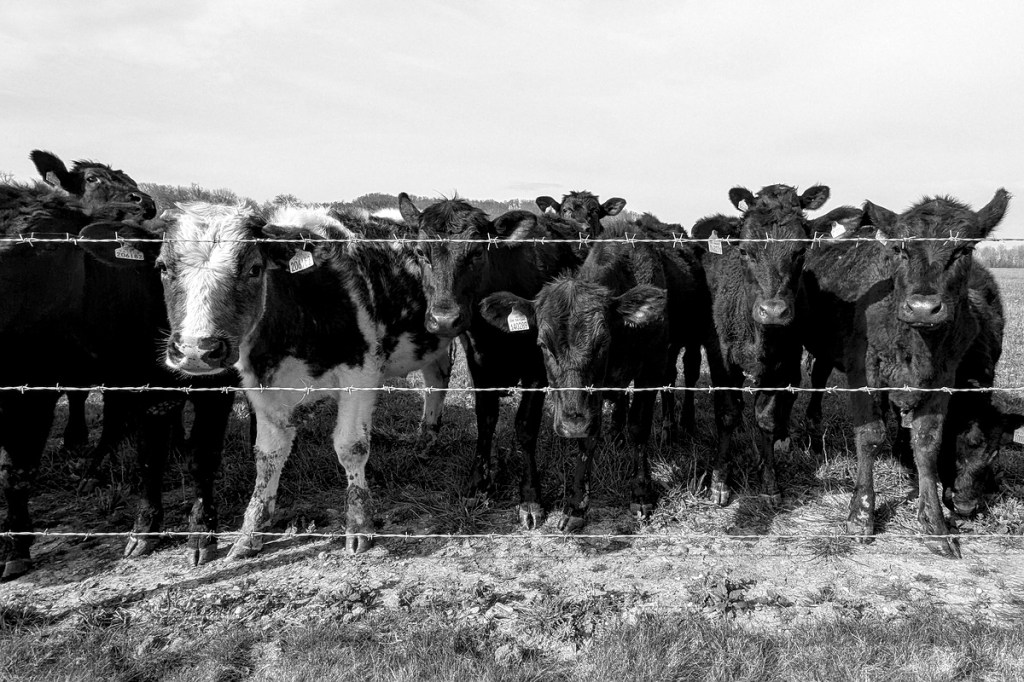
In the morning I’m on the farm as an extra pair of hands while some young cattle are being de-horned. In the afternoon I’m reading J.M. Coetzee’s The Lives of Animals for the first time.
Morning: On the Farm
De-horning is a grim job. It’s a bit medieval: giant metal cutters slamming shut, a spurt of blood shooting across the yard, a hot iron, burning, smoke and a very distinctive smell.
It’s not a job I’d do. But the vet is good, very methodical, and it helps that he’s the size of a house. A former shot-putter apparently. ‘I’m stronger than I used to be.’ It looks like he could do it all with his bare hands if he wanted.
Human beings do what we can to make it as painless as possible for all concerned. The cows get a local anaesthetic, so they feel no pain during the procedure, and a longer-lasting painkiller: like going to the dentist, you feel pressure and vibration but no pain. Of course it’s still stressful. Speed and accuracy and no nonsense are what’s needed: just get it done, rightly, then they can get back to their calm lives.
One young cow wasn’t as calm as the rest so was given some ‘sleepy juice’, for her sake and for the vet’s: who is, let’s remember, working at the spiky end of a half-ton beast. He told a story about a co-worker who’s only just getting back to work having had 6 months off with a broken leg, earned from getting the wrong side of a cow while testing for TB. ‘You’ve got to keep your wits about you.’ That’s the final word on farm vet health and safety because there’s only so much you can do. We all trade stories of close calls, some closer than others.
This is one reason for de-horning. Horns add another quite significant layer of danger to what is already a dangerous job. Imagine you were up a ladder, working at height, and while you have no intention of falling, if there happened to be some giant spikes sticking up on the floor beneath where you’re working, waiting to impale you if you fell, you’d likely acknowledge the greater danger that these spikes bring: not just a broken leg but gory death. You might remove the spikes before you climbed, if you could.
The farmer I work for had a very close call some years back. Working alone, a cow took against him, knocked him down, went to finish him off. She had a good go. He’s only alive because someone else happened to be nearby and was able to deter the cow long enough for him to get away. He was left with broken ribs but, miraculously, no lasting damage.
It would’ve been a very different outcome had the cow still had horns.
But even so, for all that, for me, that makes de-horning a necessary evil but still an evil: we do it for our sake, not for theirs. Can de-horning be a good?
The other reason for de-horning is that it’s safer for the cows themselves: they’re more likely to injure themselves or others if they have horns. In the wild this would’ve been good, which is why evolution armed cow-like creatures with horns, because the ‘other’ that the cow wants to injure is a predator or else a rival: they want the power to kill and maim, should they need it. But in the farmed environment they have no need for this power: there are no predators and there are no rivals. Farmed cows need no weapons, so we disarm them for the damage that weapons can do.
It’s like having a hand grenade lying around. In a war, this might make sense; but in peace, with a toddler about the house, you’d rather get rid of the hand grenade for the sake of avoiding the indiscriminate danger it brings.
So I know why it’s done. And I’m not going to object to it: as a worker I just get on with it. But still even so, if I’m honest, of all the jobs on the farm, de-horning is the one I might be inclined to drop entirely if I were in charge. I’d do what I can to breed horns out of the herd and get a vet to disbud the rest.
But I wonder if I’m just being too sensitive. Would I feel the same if it weren’t so brutal?
Afternoon: On The Lives of Animals
I can’t read this book without hearing the voices of all the others who’ve said similar things over the years: in academic conferences, seminars, or journal articles. I suspect that’s not fair on this book, but that’s as it is: there’s nothing I can do about it now.
I fear too many people might have read this book and naively considered it a validation of their views: that in hand, they hold forth with greater confidence than is warranted.
Because although this is a good book, full of self-reflection, it gives no good reasons. Coetzee knows that: it’s why he’s constantly self-deprecating and has his protagonist come across as hostile to reason as such. It’s not clear whether we’re supposed to agree with her.
Coetzee tries to leave it at that: ambiguous; thought-provoking. Those that followed have been more ambitious.
~
Livestock farming is like the Holocaust. Not like: it is a holocaust. And we are all of us complicit in this ‘crime of stupefying proportions’.
Bold words, and fearless thoughts. But there are some thoughts we should fear to think and some words we should rightly hesitate to say.
Coetzee is aware of the impropriety of this ‘blasphemy’ and includes a counterpoint in the book, but there is something worse, I think, in his acknowledgement of it. He places, in the letter of ‘a poet’ (a Jew, one is too-bluntly led to assume by the name: ‘Abraham Stern’), an accusation of a logical error: just because the Jews died like cattle does not mean that cattle die like the Jews. ‘That is a trick with words which I will not accept. You misunderstand the nature of likenesses.’ But the wrong – by which I mean moral wrong – of comparing livestock farming with the Holocaust seems to me to be only repeated if you treat it as a logical matter: a play with words.
Coetzee allows (and insists upon) the full weight of poetic expression in saying his bold words on behalf of farmed animals, but he only allows a little logical error, and a few loaded but slightly cliched phrases (‘insults the memory of the dead’, ‘the horrors of the camps’, etc.) to speak against him. Were we to allow the Holocaust full poetic expression, I suspect it would silence any attempt at comparison. Read Night, then come back to this and try again to speak about logic and wordplay.
I wonder, again, if Coetzee knows this. I wonder how subtle it is for him to have placed such a banal expression in the words of ‘a poet’. Thought at from that point of view, it almost seems like a confession, by the writer, that he lacks the poetic sentiment to adequately capture the reality of the Holocaust (and who wouldn’t acknowledge such a lack?): but because he lacks that sentiment, he allows himself to draw a comparison that he knows should not be drawn.
That is a precise mirroring of his principle voice in the book – Coetzee’s ‘alter ego’, Elizabeth Costello – who argues that if we had the expression of poets and applied it on behalf of farmed animals, we could not see what we do to them as permissible.
And so the critical conclusion follows: Coetzee has the poetic sentiment necessary to appreciate the plight of animals but lacks the poetic sentiment necessary to appreciate the reality of the Holocaust. He only really sees one side. That asymmetry being as it is, he naturally draws the comparison.
I suppose that means we could call it ‘biased’. It is a perspective, but it is not a reliable perspective. It is something we might be able to learn from but not something we should take as true.
Consider someone in love: they speak about their beloved in the highest terms. It is a perspective, and we can learn a lot from this. Poetically, their too-lofty words tell us something important about love and the human condition. But we don’t think that what they’re saying is true. The beloved isn’t really so over-and-above the rest of humanity as the lover makes out, even though it might seem that way to them. Their perspective is not reliable, because they are in love. Their perspective is distorted by the best of reasons.
O me, what eyes hath Love put in my head,
Which have no correspondence with true sight!
Shakespeare, Sonnet 148
In my view, something similar is going on with Coetzee’s perspective on animals, and in all those who share his views. Their admirable sympathy for animal suffering is taken too far, distorting their perspective like a lover’s love. They are left blind to their biases and inconsistencies and errors.
O cunning Love! with tears thou keep’st me blind,
Lest eyes well-seeing thy foul faults should find.
~
Coetzee is a writer. He sees no problem with inconsistency. He speaks dismissively of this in the book: ‘Consistency is the hobgoblin of small minds.’
That’s an equivocal allusion to Emerson, for the ‘foolish consistency’ (Emerson’s original but my emphasis) to which Emerson refers, which constrains the small mind, is ‘thinking the same thing from one day to the next’, whereas Coetzee seems to be talking about an entirely unfoolish consistency of applying universal rules universally and not partially: if it’s wrong to kill animals for their meat, it’s wrong to kill them for their skin, etc.
A philosopher understands that ‘consistency’, in this form, is nothing less than an appeal to the law of non-contradiction. That sounds trivial to untrained ears, but with a little cultivated understanding you recognise that the law of non-contradiction is what underpins all meaning as such. Take it away, belittle it, and you will be left unable to hold a thought or say a word; you will be unable to disagree; you will be unable to assert anything as true because nothing can be false.
But this book, or the view it represents, is riddled with naive inconsistencies. Coetzee revels in that (the inconsistency, not the naivety) because he means for it to express something that he thinks is important. And it is important, like love is important. But, like love, it’s still accountable. What seems like love can turn out to be lust, pity, infatuation, envy or jealously, a misplaced sense of duty, a fear of being alone, or so many other corrupted forms. To preserve the truth of love we must protect it from its false forms: for the sake of that we need to see that there are true and false forms. Errors are still errors, and if a view is founded on an error then it’s important that that is drawn out so that we can see it for what it is.
~
Coetzee offers reasons against his protagonist’s view, utilitarian and hedonistic and rational. But there are reasons beyond utilitarian and hedonistic and rational. Our reasons are not exhausted by ‘we should do this because it’s good for the many and only bad for the few’ or ‘we should do this because we enjoy it’ or ‘we should do it because we can do what we like to objects’. These are straw men, easily burned. As a livestock farmer, I recognise none of them.
Coetzee sets up a false dichotomy, too simple to be unintentional, between the hunter and the ‘ecology-manager’, as if these are the only two ways that human beings can interact with animals. But there are many other ways of living alongside animals than that.
Coetzee insists (by repeated assumption) that to acknowledge human beings as essentially ‘intellectual’, and understand that this marks out our essential difference from non-human animals, carries some normative weight. But I acknowledge that essential difference very strongly – as a philosopher, that is only natural: for me a human being is a ‘rational animal’ – and I don’t think it carries any normative weight at all. It seems absurd to me to suggest that the wrongness of killing a human being lies in the fact that they can think about it, in their self-awareness. If they cannot or do not think about it, does that make it ok? Is it more wrong to kill an intelligent person than a stupid? If I find someone sufficiently stupid, can I do what I like with them?
Besides, animals aren’t nearly as stupid as intelligent people think. I’m fully on board with the notion that we are all animals, all expressive of our distinctive natures, and that the intelligence of human beings has no special priority. As Coetzee says, while a monkey might struggle to use a computer, put me in the jungle and see how long I last, then ask again who is ‘superior’: you’ll see that the only sensible answer there is ‘it depends’.
But while we are all animals, humans and non-human animals are not the same. Don’t try to explain that but only ask if it’s true. It is. It obviously is. And it follows from that that the crime of farming animals is not the same crime as the crime of farming humans. If they are crimes, they are different, and because of that difference what makes sense to say of one does not make sense to say of the other.
That is why people would say that to draw a comparison between livestock farming and the Holocaust is to deny humanity. Not because human beings are ‘special’ (although some might believe that), or because non-human animals don’t matter, but because there is an important difference there that should not be dismissed.
That sounds underplayed. Everything sounds underplayed when you talk about this kind of thing.
I would, rightly, fear to speak about the Holocaust. I would hesitate to use it as a play in a game. That is putting it too mildly. I would not do these things, because it would be wrong. The reality of the Holocaust is mind-stopping: it ‘afflicts the mind with blankness’ and ‘halts the tongue’. Recognising that, I stop. I place my hand over my mouth. I’ve said too much already.
Coetzee does not stop but falls back on cliches and logical objections because he has nothing else to say. I’d rather not repeat that error.
~
In the end, in a word, I would describe this book and the view it expresses as ‘naive’. Naive about philosophy and naive about animals. And since I think human beings are, at their best, philosophical animals, then I would have to say that this book is naive about human beings too.
But after that haughty and very petty accusation, finally my response is compassion. Sympathy. I think this is an honest expression of a view that is widespread and spreading. It troubles more people more and more. They cannot come to terms with the reality of it. They are trapped in a moral tragedy, offended by something that cannot be avoided: death and suffering and the instrumental use of death and suffering for the continuation of life.
Nature is endlessly digesting its dead parts. That is what life is. We thinking monkeys are just in the unfortunate position of being aware of it and so having to make a choice about it. How should we live, if living trades in death?
~
I think there’s something in the idea that, if all virtues lie between excess and deficiency, then as much as a distinctively moral sensitivity is a good thing, you can have too much of it: you can be too sensitive. You can let something bother you too much, not because it’s not as bad as you think, but because it’s a reality that can’t be avoided. In those cases, you’ve just got to get on with it. Things die; things eat things; it is pain and suffering and striving. If you opened your heart to the reality of this, allowing yourself to feel it all with full force, you’d go mad for the horror of it all. You’d want no part of it. But this is no way to live, only a shortcut to death. If there is a way to live in truth, it must be a way that accepts these facts of life and doesn’t hide from them. To be fully truthful, it might even be necessary to embrace them.
~
If you were to think about so many things in life like this, with the maximal amount of moral sensitivity, and then try to account for them rationally, try to make them make sense, you’d fall short.
Think about childbirth. Think about the pain and damage it does to a woman’s body. Think about the gross injustice of a man planting a seed, enjoying it greatly, then walking away to let nature take its savage course. Think of the horror of an ‘other’ life growing in you, parasitic, feeding on you, changing you for its sake, before bursting out of you in blood and flesh-ripped: a horror captured so distinctively in the Alien films. No one who thought of childbirth like this would reconcile themselves to it. No one could defend the factories of pain (that we call maternity wards) run by those complicit in the treatment of child-bearing women, women who die in their hundreds every day, screaming for a god that will not help them and cursing the man who killed them. It is monstrous; it is inhuman. It is barbaric and it should stop.
These reasons are all true, from a certain point of view, so if there’s something wrong with the view, it isn’t the reasons for it.
Think about it in a different way and it might make more sense. People say it is natural. People say it is healthy. The pain of childbirth (so they will say) releases brain chemicals that a) reduce the pain, b) help the mother-baby bond, and c) help the baby. The literal shit you are born in helps to establish your infant microbiome. It is part of what it means to be a mammal; it is part of what it means to be human; for some women (though not all) it is a particular part of what it means to be a woman. There are both women and men who are envious of a woman’s ability to bear children, and no one could envy something that bad… It’s an insult to doctors and nurses and midwives to call their place of work a ‘factory of pain’: they do their best to preserve and improve the lives of the women and babies in their care, even though they know that many of them will suffer greatly and die.
But think of the gore, the damage, the death. If a man were to cause those injuries directly, we would say he had committed a terrible crime: among the worst of crimes that a man can do. But we don’t say that. Instead we say it’s natural. And it is. Isn’t it?
Which is it? What should we think? What we think depends on our perspective: so which perspective should we adopt? Is childbearing a natural act of love or a gruesome act of violence?
Which view do we consider more reasonable? If someone were to come to you and express one or the other, how would you respond?
A pregnant woman comes to you and speaks freely about the joy of expectant motherhood: it is a joy that, although fully aware of the dangers, remains rich with meaning. ‘I am carrying my child and will soon become a mother.’ Life is thriving. She weeps in happiness. Do we see any reason to correct her? Ought we?
A pregnant woman comes to you and speaks passionately about the terrible crime that has been committed. The sex was very consensual, the couple are happily married, but even so the man is now physically free from the consequences of it. Of course he is supportive but that hardly makes up for the damage he has done. The woman is burdened, literally, by another life. She is traumatised by her impending doom. Soon, at a time not of her choosing, she will be ripped apart in hours or days of agony, risking death, for the sake of some other life that has done nothing to deserve it. Nature is cruel to subject women and only women to this role. To nature, women are breeders and feeders. Men are just fuckers: they can do whatever they want. It is an outrageous injustice. When you think about this on a global-historical scale, it is ‘a crime of stupefying proportions’, and we are all of us complicit in it. Life continues only at the cost of women’s lives. She weeps in helpless rage.
Do we see any reason to correct her? Ought we?
It’s not our place, perhaps, and it’s certainly not mine, but I think we can ask which position we consider to be more reasonable. We can ask which perspective we might choose to adopt, and why. I’ll leave that to you.
~
For me, I think there are certain perspectives we should not take, certain thoughts we should not think, certain words we should not say, and for good reason. When I am out in nature, I can be happily overwhelmed by the beauty of the day. But if I think about it, like a Darwinian, I can see nothing but a landscape of violent struggle, full of pain, where everything is starving, competing, and eating one another, with a thousand cruel deaths happening every second, the brutal horror of which I am only shielded from by the fact that I simply cannot see it happening or feel it happening to me. If I entertain the perspective of the rabbit eaten by the fox, or the bug eaten by the bird, or the deer injured and limping until it is too tired to do anything other than lie down and die, slowly, painfully, of starvation, or else perhaps be eaten alive (very slowly, very painfully), the natural world is a place of endless fear and terrible suffering. I can’t get my head around the scale of it all: the extent of it is literally inconceivable.
It is a monstrous injustice that I, born as a human being in this time and place, have been granted by sheer dumb luck the opportunity to pass through life without fear of predation and the many other forms of natural suffering that animal life is forced to endure every day.
Injustices should be corrected, if we are aware of them: as Socrates says, it is better to suffer wrong than to do it. I have no right to a life founded on such unfair terms. I have no desire to be complicit in this crime of stupefying proportions. I should rush back to face my punishment. I should feed myself to the wolves.
Should I entertain this perspective? Should I think about the natural world in this way? I don’t think I should. It’s not helpful, for a start, and it’s not true except from a view that we wouldn’t consider reasonable. To entertain the natural beauty of the day is healthy and sane; to entertain the serious notion that I should, by rights, feed myself to the wolves is neither healthy nor sane.
~
Health and sanity are good reasons, I think; or at least I’d call them reasonable. Not, I hasten to add, in a self-serving way: they aren’t good reasons because they are good for us. I say they are good reasons because they indicate, to us, a perspective worth taking; or at least they indicate the absence of any obvious distortion. A healthy and sane view isn’t one that ignores all the bad things (or good things) in life but only doesn’t fixate on them. It is balanced, and this balanced view shows a strong connection with things as they are.
When this connection breaks down, and something is taken too far, we notice it and call it out. One could rationally consider the possibility that waiters in restaurants are trying to poison us – after all, that is possible – but it wouldn’t be reasonable; it wouldn’t be healthy. Such a thought would be a sign of a damaged mind: we’d label it ‘paranoid’. If they believed their thought, we’d call it a ‘paranoid delusion’. We’d say their belief is false, a delusion, even though we have no evidence either way. We’d say this even if they could argue their case better than we could argue ours: and perhaps with practice they could, and with our lack of practice we couldn’t. I, for example, have no stats to hand about how many people die from food poisoning each year, but I expect the paranoid person might. I expect the numbers are higher than I realise: shocking, even. Should I entertain their perspective, on that basis, deferring to their greater understanding of this matter?
What’s wrong with their view is not their reasons or their argument. It is their view, as such, that is wrong. Their view is distorted by some force beyond reason: for the paranoid, that force is fear. (What eyes hath fear put in their head, which have no correspondence with true sight!) This distortion isn’t merely a cause of error, because we can’t always find an error: there is no obvious fault in their thinking; it really is possible that waiters in restaurants are trying to poison us; how could we prove otherwise? Given the height of the stakes at play – my life wagered against a mediocre meal in a restaurant – it might seem reasonable to weigh the odds very carefully. But to adopt this view is to buy into it, and with that take on the problematic distortion. Regardless of the conclusion of my ‘weighing the odds’, or any perceptual errors that paranoid fear might cause, the view itself is already a form of not seeing things as they are.
Fear is reasonable and natural: it is right and rational to be averse to danger and harm. But fear can be taken too far, and when it is, it becomes unreasonable. An unreasonable fear becomes a ‘paranoia’ or a ‘phobia’: even when the danger is real, it affects you too much. It dominates your view in a way that isn’t warranted.
This is how I would characterise the view expressed in The Lives of Animals. It is the view that results from a sympathy for animal suffering taken too far. It isn’t balanced by a healthy understanding of animal life as it really is.
~
Because there is no escaping the unpleasant reality of life living off death and suffering, except by pretending it isn’t there. You might not see the damage that you do by eating plant-based food, but farmers do, because they grow the food. And so many farmers say there is little discernible moral difference between plant-based farming and livestock farming. Many would say that conventional plant-based farming is in fact worse, for the damage it does to life, in contrast to extensive livestock farming.
Coetzee describes livestock farming as a war on animals that we’ve won ‘definitively’. But this ignores wildlife. Plant-based agriculture represents the war finally won. Crops are possible only because the land has been totally tamed, with all pests displaced or eliminated: a final solution enacted, again and again. Life doesn’t stand a chance: only food remains. A monoculture kills everything that isn’t it.
The process is simple and mechanical. It begins with chemical warfare: one spray and everything dies. And having killed everything on the surface, next we kill the very ground that living things lived on. If something dares to move back in, we kill it immediately. From here on out we say we kill nothing, but that’s only because we’ve already killed everything and there’s nothing left to kill. Localised genocides are rarely so successful as arable crops.
When you look out on a field of wheat, conventionally grown, you are looking at a man-made ecological desert. Nothing lives there that we do not permit to live. That is the war on nature finally won: it has no animals at all. Only food: our food.
Of course this is silly talk. Growing wheat is not genocide. But that’s my point: if you are aware of the damage done by growing wheat, you know it is not innocent. That, too, remains a ‘crime of stupefying proportions’, from a certain point of view. I would refuse to contemplate doing it in certain fields for the damage it would do to the environment there. I rank it morally far worse than many things I could do on the farm. But these evils remain necessary for growing plant-based food.1 Knowing that, I shrug and eat my bread.
Vegans and vegetarians inherit the moral culpability of this damage no different from meat-eaters. That they might think themselves to be morally superior is only possible because they pretend that the damage to life, which is the price to pay for their food, isn’t there: mostly I think they are simply unaware of the realities of farming and would be horrified to discover the truth. But ignorance makes no difference and it certainly doesn’t get you off the hook.
What do we make of a vegan who eats organic food? ‘Organic’ ordinarily indicates the use of natural fertiliser: i.e., shit. That only comes from animals: i.e., livestock farming. Ordinarily, ‘vegan organic’ is an oxymoron.
The remaining window of guilt-free food becomes so narrow that only a few very skinny people could squeeze through it: food grown according to a strict ‘veganic’ method. But the practical requirements of this method are so restrictive that the labour/land/productivity equations don’t come out in our favour. And they still kill pests when they have to, because otherwise they’d eat our food, and we can’t have that because we need to eat. But by what right do we claim that? Everything needs to eat.
Realistically, to remain productive while avoiding any use of animals requires plant-based food to be grown entirely artificially. You swap shit and grazing for chemicals and cultivation. The environmental damage inherent to those methods passes the cost-to-life on to the natural world. That makes it very difficult to see but that’s hardly the point: just because something can’t be seen and is a long way away (from you) doesn’t mean it’s not there. Don’t look at the field but look at the mine where the minerals came from, or the fossil fuels necessary for the Haber-Bosch process, or the plastic that begins in the greenhouses of Almería and ends in the land and sea and life nearby, etc., then tell me again that there is no moral cost to our vegetables.
It is the same principle that drives us to say that there is little discernible moral difference between the concentration camp commandant who gives the orders or the guard who only follows them, or the villagers who turn a blind eye and pretend they don’t know what’s going on, or the citizens of the Reich who support the general principle. All participate in this crime of stupefying proportions. It is only made possible by their collective willingness to go along with it and take benefit from it.
The crime is human life and the continued dominance of it: the so-called ‘Anthropocene’ that has remade the world to our convenience, killing most of it in the process.
Should we adopt that view, the view that sees our continued existence as a crime? You can if you like. Go and feed your children to the wolves and call it an act of justice.
I would rather do what I can to make life better for those that live, accepting that they will all die. I would rather nurture the environment and allow it to follow its natural pattern rather than kill it and reshape it, over and over again, for our convenience. I would rather give the land back to the cows and not build any more houses: we have taken enough land as it is. I would rather allow cows to contribute to the cycle of life and death and digestion, as I will, to feed the soil and the insects and the birds and the richness of life that thrives around them. But these aren’t reasons, only aesthetic preferences.
~
What is reasonable? For me (philosopher that I am) it does come back to consistency: what Coetzee dismisses as the ‘hobgoblin of small minds’. If I took objection to the crime of stupefying proportions that is the instrumental use of death and suffering for the continuation of life, I would have to object to human existence as such. Perhaps I do, but that doesn’t help me answer the question ‘how should I live?’: or rather, it only offers one answer, which is that ‘you shouldn’t’.
Besides, by that measure, I’d have to object just as much to animal existence too. I’d have to defend the rabbit from the fox as I defend the cow from the carnivore.
Consistency again: I’m not in favour of fox-hunting, but I still think it’s a strange thing that those against the practice of hunting with dogs, for its horrible cruelty, must surely know what a fox is and how it eats. Some of those same people will call for the reintroduction of wolves to control an overpopulation of deer, as a ‘natural’ method, superior to the hunter’s trained-eye and rifle. To call that view ‘inconsistent’ or ‘naive’ seems to me to be an understatement.
It’s all horrible: at least livestock farming, done well, looks after the lives that will someday end, and when the end comes it will be as quick and painless as possible. I can’t say the same for the screaming rabbit.
~
If my moral sensitivity leaves the world so unjust in my eyes that the only solution is to die, then I think my moral sensitivity has been taken too far. The view is distorted. It is not healthy or sane. It must be tempered by something beyond itself.
I confess that that ‘something’ is a mystery to me. I don’t know what makes life permissible, but I suspect it isn’t anything that reason can grasp because life certainly isn’t reasonable. I reach for something beyond reason – Nature or the Dao – but my philosopher’s conscience holds me back from mysticism. I stop where I should, which is here:
What counts as a good reason will depend on your perspective. Sometimes perspectives can be distorted, causing you to make errors: these are easily identified by the errors that are made. But perspectives can also be the error: the view can be distorted as such, in a way that causes no obvious errors. Sometimes we can only say ‘you’re looking at this in the wrong way’ or ‘you’re taking that too far’.
An acrophobic points out the danger of falling from height. They are correct to identify this danger, and it’s natural and right to be afraid of danger. I wouldn’t challenge any of that. Only their fear is taken too far: it dominates their view in a way that isn’t warranted. Their view as such is distorted. If we want to correct them, we don’t try to convince them that there is no danger – that would be false – instead we say only that their fear is too much. They must try to face their fear and for the sake of that accept a certain amount of danger. Why? Because their fear is too much. That’s all we can say: their fear is too much.
Do I mean to draw this parallel with the view of the vegan? I think I do. Most vegans I know do, as a matter of fact, have a view that is founded on false beliefs: their perspective is distorted and causes errors. They simply don’t know very much about the reality of farming, or else they have a strangely selective view of moral philosophy. You can correct all that if you like but I’m not sure I have the patience for it.
But when I read Coetzee’s The Lives of Animals, I see a perspective that is dominated, as such, by a distortion. That is the primary form of its error: not its false factual beliefs but only the distorted view. To correct that, I feel the need to do something else: only say ‘you’re looking at this in the wrong way’ or ‘you’re taking that too far’. Your natural and right sympathy for animal suffering is too much. I think you should face the ‘facts of life’ – the instrumental use of death and suffering for the continuation of life – and for the sake of that accept a certain amount of it. I think we must all find a way to come to terms with that or else go mad.
Go mad or else die to escape this madness. Coetzee does not show us how to live with the view he shows. Instead he ends the book like this: ‘There, there. It will soon be over.’ But I think it is better to try to find a way to live in truth, if we can.
~
To accept an unavoidable reality, perhaps you must embrace it. This is the temptation to the ‘primitivism’ of Hemingway. But this, too, is taking it too far. I will not look a cow in the eye and fight it to the death just to earn the right to eat it. I have no right to eat it any more than it has the right to eat me; or rather, I have just as much right to eat it as it has to eat me. Those rights aren’t changed by the rites of single combat. Only humans have rites: nature knows none. To think I could earn the right to kill and eat something, by my manly deeds, and by that make it right, is just another game of make believe, no different from those games that say we have a right to kill things because of our God-given right, or intellectual superiority, or technological or artistic achievements.
Rights are a human thing, reasons are a human thing, language is a human thing, and so the language of rights and reasons will always fall short when it comes to our relationship with animals. Ask an angry bull to respect your rights and see how far you get. It’s silly talk.
For a relationship to be just, it must not be one-sided, and so there’s something unjust about imposing rights on animals. Please don’t misunderstand that: I am not against animal rights. I’m in favour of ‘animal rights’ for the good it does for animals, only I’d put that in scare quotes because I’d say that the language of rights doesn’t go far enough: it only elevates animals beyond objects by making them our subjects. But in truth they are neither: they are their own and they have their own ways. I would rather respect their life on their terms, not mine. To do our relationship justice, I would rather align with their ways, balanced against mine.
This is what I see livestock farming as, in its virtuous form: an attempt to align with animal life in a distinctively human way. Done rightly, it is as kind as it can be, but it is also efficient and pragmatic. We work in a symbiotic relationship: without my work, they suffer and die; without our appetites, they do not live at all; without their deaths, the herd does not continue. On the farm I work on, around 20% of the herd leave the farm each year (I say ‘leave the farm’ because we don’t tend to sell to slaughter but that’s a minor point). That is proportionally more than would die naturally, but nature would be crueller. The majority of the herd, in any given year, continue to live calm and happy lives.
It is a trade in death: all life is. The unreasonable horror of existence is mind-stopping, but I would rather immerse myself in it than run away or pretend it to be other than it is. For the sake of that, like the phobic, I will turn to face what troubles me, and for that accept a certain amount of it.
Livestock farming, done rightly, is kinder to animals than nature could ever be. Kindness is another human thing, like rights and reasons: nature doesn’t know it. Nature is what we would call cruel, but of course that is a category error: it’s only cruel according to our standards. Nature just ‘is’, and in nature there is starvation, predation, disease, and an awful lot of infant death: this is ‘nature’s way’, so we say, of weeding out the weak, but even that reads too much purpose in it. Nature is blind to what it does. By contrast, we see what we do and so we do what we can: in the farmed environment, there is no starvation, no predation, minimal disease and maximal medical care. The herd lives a long and happy life: for that some of them must die. In exchange for that death, life thrives around them: soil, plants, insects, birds, mammals, and the rest.
This, I say, is natural life in human terms. It is far more natural than a sterile field of wheat that minimises life for our convenience.
~
There are realities beyond human convenience. The only way to end animal suffering and death is to have no animals at all: that is as true for humans as it is for non-humans. I don’t think that having no animal life at all would be a good thing. But it follows from this that we must accept some animal suffering and death. I would rather make that necessary evil as good as it can be, and find a way to come to terms with the remainder.
For me, that indicates a virtuous form of livestock farming: extensive, organic, ‘regenerative’, aligned with nature, benefitting wildlife, and held to the highest welfare and ethical standards. So that is what I will do.
I won’t say that you should do the same. And you can eat or not eat whatever you want: that’s not my business. But I would say that you should turn to face what troubles you and ask yourself whether it might be necessary to accept a certain amount of it.
Footnote
1: The alternative is organic, regenerative, or other non-conventional cropping methods. These are much better, environmentally, but their viability depends on the use of animals and animal products, principally their shit or grazing activity. Once again, there is no avoiding the instrumental use of life for our food.
 tobybetenson.com