-
Happiness, According to Aristotle

If everything we do, we do for the sake of happiness, what is happiness? What is it to live well? What is it we are aiming for? Aristotle’s answer here depends on his metaphysical categories. That’s enough to put some people off. But even if we are not on board with his metaphysical reasoning, the answer he gives is profoundly insightful and has been tremendously influential. It’s very much worth some serious consideration. […] read more
-
The Purpose of Life, According to Aristotle
What is a good life? What is ‘Good’? Socrates and Plato would say that these are very difficult questions to answer, requiring an almost other-worldly kind of wisdom. Not so for Aristotle, whose method brings us right down-to-earth. What is ‘Good’? Well, look around, what do you point at and say ‘that is good’? […] read more
-
Aristotle’s Theory of Causation
What is it for something to ‘cause’ something else? This is a very difficult question to answer. No science or philosophy has yet really settled the question, in fact, and it remains a topic of serious debate now and for the future. We will leave that debate for the metaphysicians and focus on Aristotle’s version. […] read more
-
A Very Brief Introduction to Aristotle’s Metaphysics
Aristotle was a very down-to-earth philosopher. He said we should trust observation over theory, and trust theory only if it matches up with the observable world. If you want to understand something, look first, think after. That might be a good slogan for Aristotle’s approach. So what do we see when we look at the world? […] read more
-
Properly Basic Moral Belief

According to Alvin Plantinga, religious belief is properly basic because it is involuntary and it arises from a properly functioning natural faculty that, if its origin story is true, grants the belief epistemological warrant. Is there any reason to suppose moral belief, especially at its limits, is any different from a properly basic religious belief? […] read more
-
Recognising Moral Necessity

Do you recognise anything to be morally necessary? I can easily imagine that many of you don’t. Scepticism is easy, and in any case easier than holding yourself to account. It’s easy to overlook or dismiss the morally necessary because most of the time we live in a murky world of moral contingency and epistemic uncertainty. But every now and then we hit upon a clear moral limit. I have sometimes found these limits in my own life; life has shown me what I believe. I imagine some of you have experienced the same. […] read more
-
The Educative Power of Extreme Examples

Philosophers are often found reflecting on extreme examples of moral good or evil. When political philosophers talk about justice, they refer to utopian ideals that have no realistic chance of being realised. When we discuss ‘The Problem of Evil’, we talk about the Holocaust, or Hiroshima, or the worst forms of child abuse. These are extreme examples that hardly any of us face in real life (thankfully). Often they are outright fictional, as is seen when we discuss classic examples from literature and film. To many non-philosophers, this might seem like a waste of time and talent. […] read more
-
Pandering
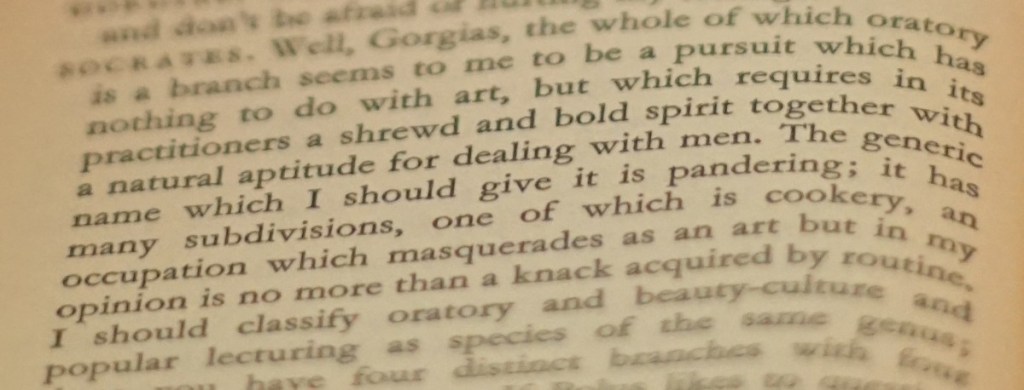
Recently, I’ve been running a series of posts about the problem of evil. Much of it is recycled from my book on the subject. The main motivation for this is SEO: I want to teach the Google bots that my writing here is what should be read, rather than my old academic writing. Ancient Greek philosophers had a word for this kind of thing: κολακεία. It is variously translated as ‘pandering’ or ‘flattery’. It means playing to the crowd. In my case, it means trying to give the Google bots what they can understand. […] read more
-
Ivan Karamazov is a Hopeless Romantic

Ivan Karamazov, from Dostoevsky’s The Brothers Karamazov, is often paraded across the philosophical literature on the problem of evil, made to stand as an example of a particular kind of argument from evil, one that is concerned not with the quantity or severity of evil in this world but with a certain qualitative type of evil. I think Ivan is often misunderstood. Or rather, Dostoevsky is often misunderstood, in the way that Ivan is put to use in the context of the philosophy of religion. […] read more
-
Evaluative Claims within the Problem of Evil

When it comes to the problem of evil, I’ve always felt there was something wrong with someone trying to argue for a factual conclusion on the basis of moral premises. Saying ‘God does not exist’ sounds an awful lot like a statement of a fact, like a claim that ‘no human being that exists is over 10ft tall’, but the grounds for this fact are at times little more than a report of your moral feelings. Ordinarily, we wouldn’t give this kind of argument the time of day. […] read more

An experiment with philosophy as a way of life

