-
Happiness, According to Aristotle

If everything we do, we do for the sake of happiness, what is happiness? What is it to live well? What is it we are aiming for? Aristotle’s answer here depends on his metaphysical categories. That’s enough to put some people off. But even if we are not on board with his metaphysical reasoning, the answer he gives is profoundly insightful and has been tremendously influential. It’s very much worth some serious consideration. […]
-
The Purpose of Life, According to Aristotle
What is a good life? What is ‘Good’? Socrates and Plato would say that these are very difficult questions to answer, requiring an almost other-worldly kind of wisdom. Not so for Aristotle, whose method brings us right down-to-earth. What is ‘Good’? Well, look around, what do you point at and say ‘that is good’? […]
-
Recognising Moral Necessity

Do you recognise anything to be morally necessary? I can easily imagine that many of you don’t. Scepticism is easy, and in any case easier than holding yourself to account. It’s easy to overlook or dismiss the morally necessary because most of the time we live in a murky world of moral contingency and epistemic uncertainty. But every now and then we hit upon a clear moral limit. I have sometimes found these limits in my own life; life has shown me what I believe. I imagine some of you have experienced the same. […]
-
The Educative Power of Extreme Examples

Philosophers are often found reflecting on extreme examples of moral good or evil. When political philosophers talk about justice, they refer to utopian ideals that have no realistic chance of being realised. When we discuss ‘The Problem of Evil’, we talk about the Holocaust, or Hiroshima, or the worst forms of child abuse. These are extreme examples that hardly any of us face in real life (thankfully). Often they are outright fictional, as is seen when we discuss classic examples from literature and film. To many non-philosophers, this might seem like a waste of time and talent. […]
-
Pandering
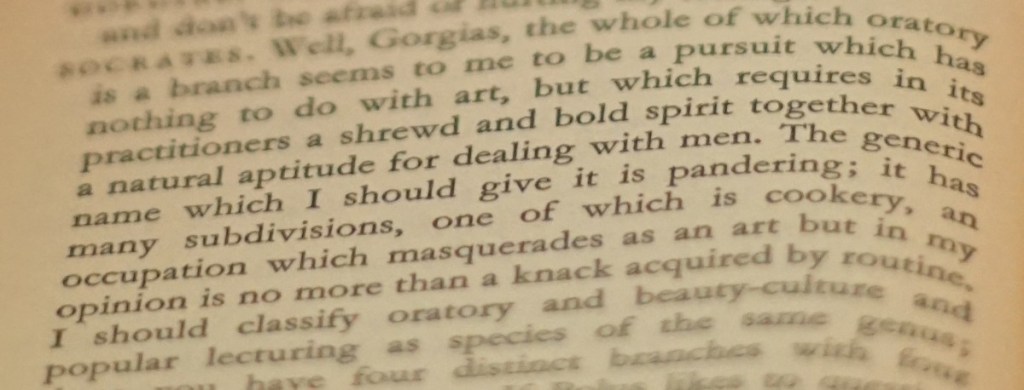
Recently, I’ve been running a series of posts about the problem of evil. Much of it is recycled from my book on the subject. The main motivation for this is SEO: I want to teach the Google bots that my writing here is what should be read, rather than my old academic writing. Ancient Greek philosophers had a word for this kind of thing: κολακεία. It is variously translated as ‘pandering’ or ‘flattery’. It means playing to the crowd. In my case, it means trying to give the Google bots what they can understand. […]
-
The Problem of Evil is Not an Intellectual Problem

In my book on the problem of evil and elsewhere, I present an argument to the conclusion that theism is morally problematic. But it would be a mistake to think that I am pronouncing judgement on the theist. And this is certainly not an argument for atheism. This argument is a result of my reflections on the problem of evil as an ethical problem, not what we could call the ‘intellectual problem’ of weighing up the rationality of theistic belief. […]
-
The Product of Philosophy
The function or task or proper work (ergon) of philosophy is only to think well. But in thinking well, you realise that our purpose or goal or aim (telos) as human beings is to live well; by which we mean to live in a way that is ethically excellent, among other things. And so the product of philosophical activity becomes just that: to live well by thinking well.
-
A Philosopher’s Verse
Is this the purpose of philosophy / Just to know, and not to be? / Just a show so not to see / Your own lived inconsistency? […]
-
The Meno: How to See What Isn’t Said
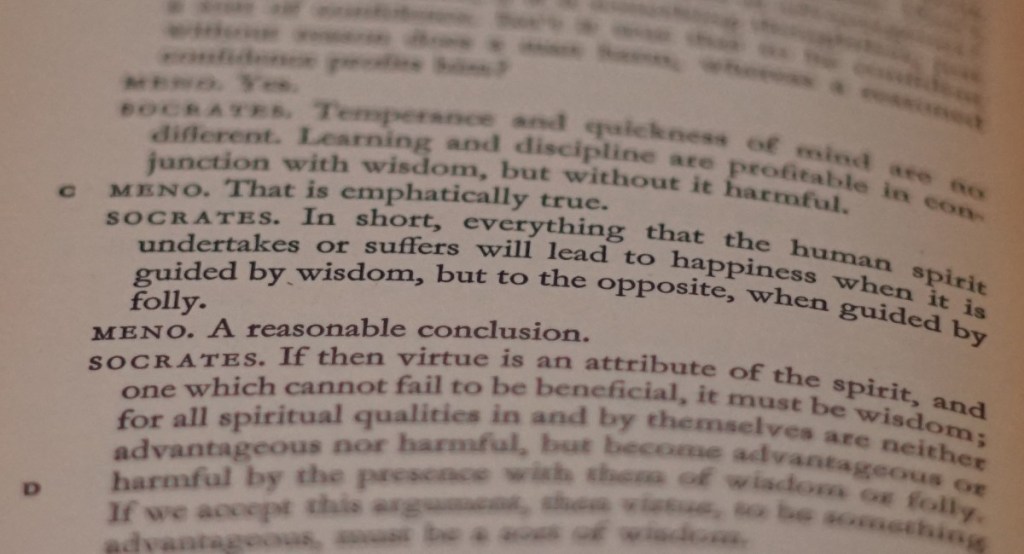
The Meno is one of the most complicated yet clear examples of Plato’s way of ‘showing one thing whilst saying something else’. Elsewhere I’ve described this as writing with layered intentions: on the surface there are some philosophical arguments with which you may or may not agree; beneath that there is a show of doing philosophy in a certain way; and beneath that there is a provocation to do it yourself. What’s on the surface isn’t really what the dialogue is about. […]
-
How To Read Plato

Academic philosophy ought to be teaching this but unfortunately it has become shallow and stupid. Or perhaps it thinks that students have become shallow and stupid and are only capable of understanding superficial arguments. Either way, it neglects what really matters, and too much is lost in that. When reading any of Plato’s dialogues, to understand them properly you need to remember these three things […]

An experiment with philosophy as a way of life
 tobybetenson.com